
Posted September 29, 2026 by Kelly Tuttle, Manuscript Data Curation Fellow
A question we often hear from new members of DS is a variation of, “We have in-situ manuscript fragments in some of our other items, but they aren’t cataloged separately, can you do anything with them?” Yes, we can. This month, let’s take a look at ways a few institutions have made their fragments available and then propose some steps if you have such a collection that you’d like to surface. My first recommendation would be, however, to keep note of these fragments as you see them, so you do not have to go back through the collection looking for them again when you want to add them to DS.
Most institutions, it seems, do not catalog in-situ fragments separately. Instead, they mention them within the record for the manuscript or printed book item to which they are attached, which I will call the host item. One such example is the University of Kansas MS E263. This record is quite lengthy and in the description, you can see there is mention of two different manuscript fragments, one under each pastedown. The fragment at the back has been removed, but remains shelved with the host. Neither of the fragments has had any of the text identified. Mentioning the fragments in another record does make it a bit more difficult to find them, but by looking for ‘in situ’ in the general search, they are for the most part findable.
Here is an example from the University of Chicago that has a fairly robust record for the manuscript fragment.
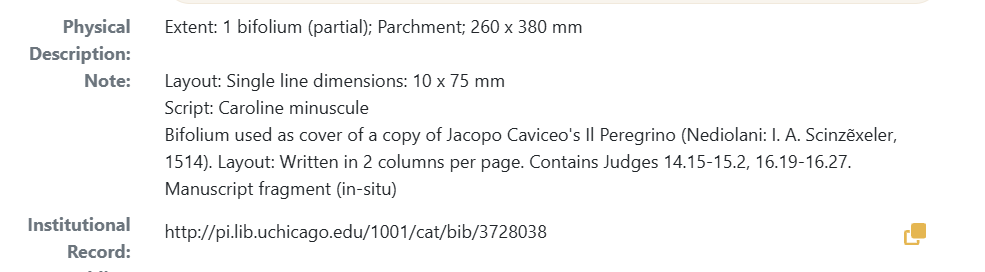
As with the University of Kansas record, the shelfmark for this manuscript fragment is the host item, in this case, the printed book, PQ4617.C75P4 1514. Since the host item is a printed book, however, we know that his record must be for an in-situ fragment since only manuscript items are recorded in DS.
The Sutro Library in the California State Library also uses the same shelfmark for both the item and the fragment. Differently from the University of Kansas record, the Sutro Library has two records in DS, each directed to a different item. You can see the binding waste fragment item record and manuscript item record, each with its own DS number. The record for the host item also has images, so you can see both of the items together in one view.
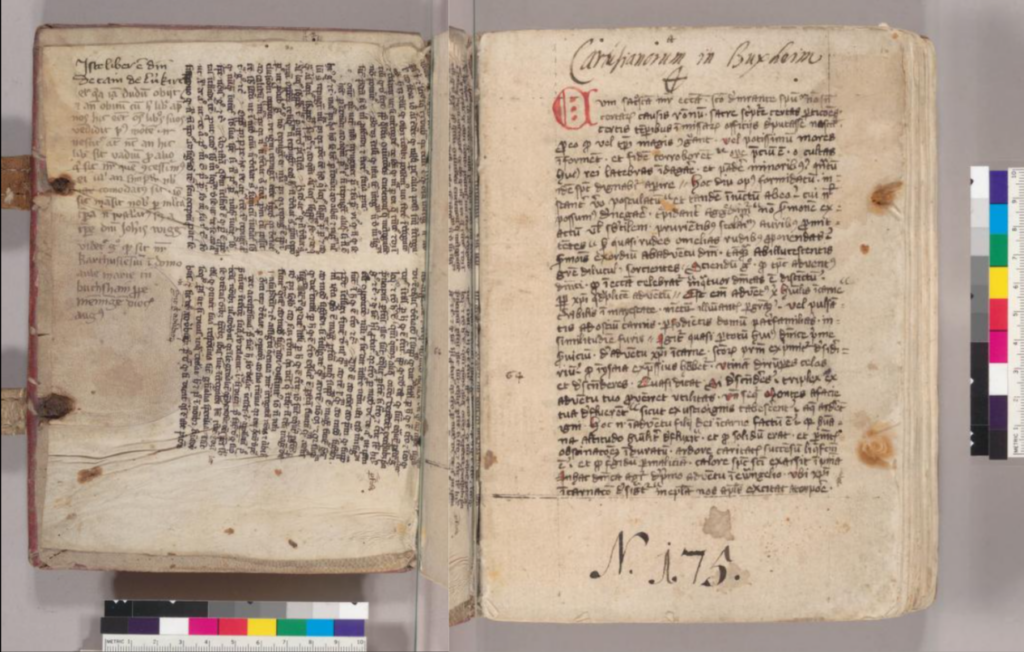
The in-situ binding fragments mostly do not have images in the records in DS. Sometimes, if the fragments are in a manuscript item, then that item will have images, as with the Sutro Library image above. For the most part though, in-situ fragments have not been photographed. It is still helpful to list the fragments in DS, even without images. Their listings can alert interested researchers to the fact that you have such a collection, something that may have been unknown or unremarked before.
Another institution that has added their binding waste fragments to their DS records is the Harry Ransom Center. Again, the shelfmarks that they use in their DS records are those of the host item. See, for example -o- Incun 1477 R134p, which is the DS record for the parchment leaves that are used in the cover for that incunable. If you go to their institutional record, you are able to find out a little more about the situation of the fragments that you cannot currently see in the DS record. Furthermore, in the institutional record, the binding fragment is listed as “-o- Incun 1477 R134p Fragment”, which, in my opinion, makes more sense than having the same identifier for both the host item and the fragment.

If shelfmark means literally the location of an item on the shelf, then it makes sense to use the same shelfmark for both the host item and any fragments that are attached to the host, since they are all in one place, indeed in one codex. If, however, we are trying to distinguish between the host item and the fragments by using identifiers, then it is probably more helpful to list the fragments as ‘Shelfmark + Fragment + Number’. So, for example, the University of Kansas record we looked at earlier would become MS E263 Fragment 1, and, since there is more than one unrelated fragment in that same host item, the second one would become MS E263 Fragment 2. This naming convention can help distinguish, just by looking at a list of identifiers, which item is the fragment and which the host. It also tells you to which item the fragment is connected, so that if you need to call up that item in the institution’s own catalog, you have that reference.
I’m bringing this up now not only because we have gotten this question many times recently but also because there is a project ongoing at Penn Libraries to create a spreadsheet list with preliminary record data of their manuscript binding waste and to use it to add those records to DS. I suspect such projects may be happening elsewhere. At the very least, there is potential for such a project to be undertaken anywhere that has early printed books or manuscripts. Let’s take a closer look at the Penn project for ideas that may be transferable to other such projects.
The Provenance Online Project was started in 2011 by the Rare Books Catalogers in the Kislak Center for Special Collections, Rare Books, and Manuscripts at the University of Pennsylvania.The goal was to collect and display ownership features of printed books, i.e., stamps, inscriptions, bookplates, notes and to get help from the public in identifying anything that had not previously been identified. Since it was a project that relied on the public seeing images of the provenance indicators, the photos were housed on Flickr, a public photo repository. Information that the catalogers had available or could determine was added to the photo as a description.
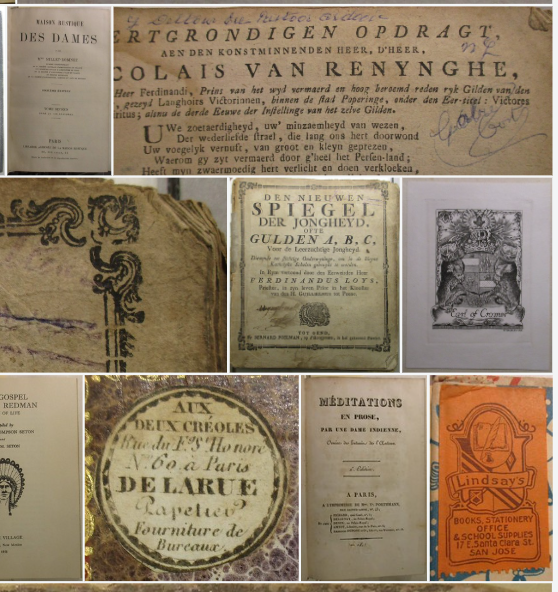
The project also includes photos of pieces of manuscript that were reused in bindings or as stabilizers. An album was put together to collect all of those images of recycled leaves into one place, but it does not distinguish between printed matter and manuscript.
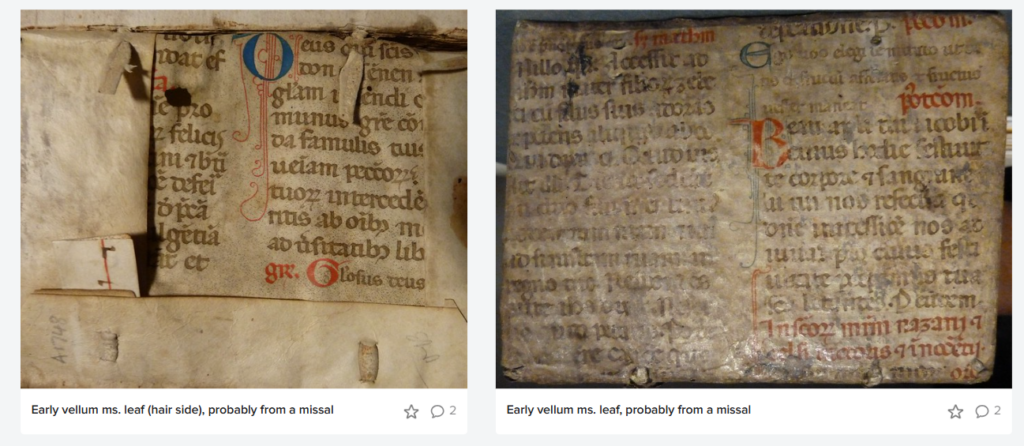
Since searching on Flickr is not easy and since there are pop-ups and border ads and such if one does not have a paid account, and since manuscript binding waste can be cataloged in DS, now seemed like a good time to try to move and consolidate the metadata about these binding fragments into DS.
Let’s conclude with some steps for working on a fragment metadata ingest project for DS. The first thing would be to find the fragments in your collection. Then, if you do not already have one, you would want to determine an identifier naming convention that will simultaneously link the fragment to the host item, but also distinguish it from it. Next, if you do not plan to catalog the items in your own catalog or create MARC records, for example, you could use the ds-csv to supply as much descriptive metadata as is available about the fragments. You could recruit students or other parties interested in learning paleography to help, but remember, you really only need a holding institution name an an identifier to add the record to DS. The barrier is low! Lastly, you send that csv to the DS staff with your yearly update. Ta da! Your fragment collection will be findable in DS and you will have a spreadsheet with your collection metadata that you can do whatever you want with locally.
I recognize that you will still need someone on staff who has time to look at fragments and type things in the spreadsheet. DS is here to help! If you need assistance organizing or moving metadata into the ds-csv, or you want help with description, let us know. This is a way to surface a subcollection and make the metadata available to everyone.