
Posted April 28, 2026 by Kelly Tuttle, Manuscript Data Curation Fellow
Digital Scriptorium is a work in progress and will always be a work in progress because new members will join bringing new data and current members will continue to revise their data as new discoveries are made in their collections. As I was cleaning and updating data this month and cataloging uncataloged items for some of the member institutions, I was thinking about looking this month for manuscripts in the DS catalog where you can really see the work in progress. This is most noticeable with illustrations and illuminations and, although these are a bit trickier to find because of the way different catalogers list levels of incompleteness, there are at least three in DS that we can look at more closely. We’ll take them one by one.
As you probably already know, the text of the main work is generally written first, before illustrations or diagrams, and plain text is put in before any kind of headline text including colored or gilded text (called rubrications) or any illuminated initials. It is generally easy to see when something should be there and isn’t; there is often an obvious empty space on the page. Two examples are below. In each, you can see the gap in the main text indicating that something else should have been added later. In the first example, two two-line initials are missing and in the second, rubrics for guiding the reader were never added.
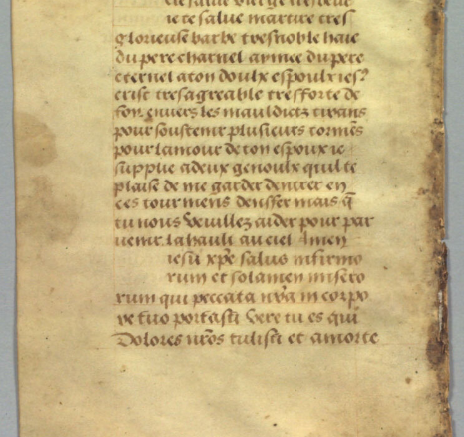
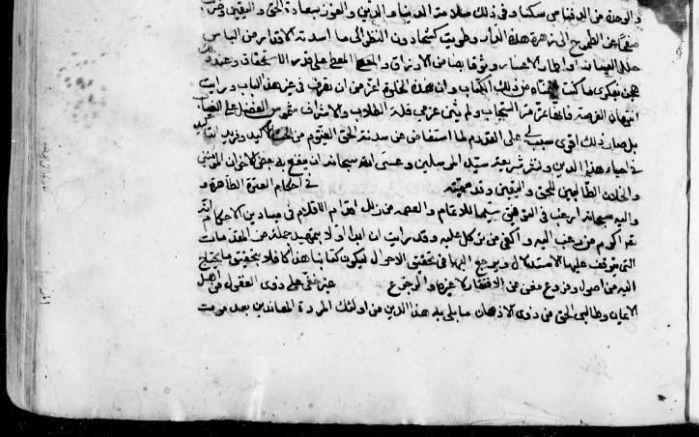
The scribe of the main text will know where the decorations should go and leaves spaces for them so they can be put in later. Indications for these embellishments may be noted on the far edge of the manuscript so that they will be trimmed during binding. In all of these examples, the decorative elements just weren’t added for some reason, perhaps it was too expensive to have the manuscript finished at the time. More interesting to me than manuscripts that show missing initials or borders (of which there are numerous examples in DS) are manuscripts that have both partially completed and fully completed illustrations, of which I found two examples, one from Harvard and one from Bryn Mawr. I was also told about a third that is in DS from University of Pennsylvania by Amey Hutchins, the manuscript cataloger there. Furthermore, though these manuscripts are separated from each other by place (Italy, India, France) and time (later 15th century, later 19th century and probably early 16th century), the ways in which the illustrations are incomplete is somewhat similar, although the third example is curious as you will see.
For all three manuscripts there are examples of blank spaces left for illustrations that were never supplied, illustrations that are partially complete in varying degrees and then completed illustrations that have been entirely painted. Also similar is that there does not seem to be any kind of progression in completeness through the manuscript; the manuscripts do not go from more complete to less but jump around. All the manuscripts show completed and partially completed paintings interspersed with blank spaces throughout the entire work.
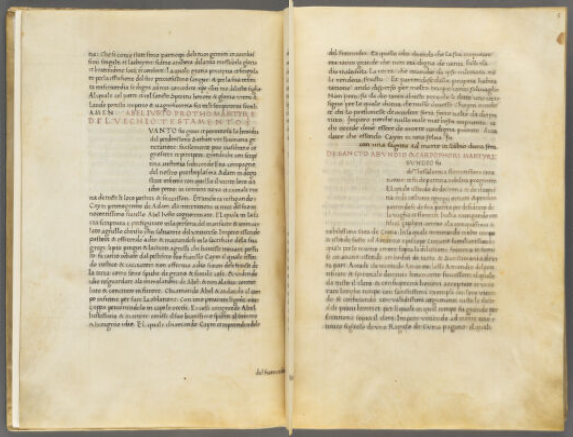
Let’s look first at Harvard University, MS Typ 142, which is an Italian copy of a book of the lives of the saints produced around 1480 CE. It contains spaces for many miniature paintings as well as initials and other decorative elements, all of which are in various states of completion, including blank.
In this first example, we see that the text was laid out and space left for the image of the saint, the initial at the beginning of the paragraph describing the saint and also possibly some extra decoration in the remaining gaps. Note that the headline of each paragraph is already rubricated in a dark red, so one stage of the finishing was completed, since the single-color rubrics all seem to be present in the manuscript. It is the following stages of painting the miniatures and adding illuminations that were not systematically completed.
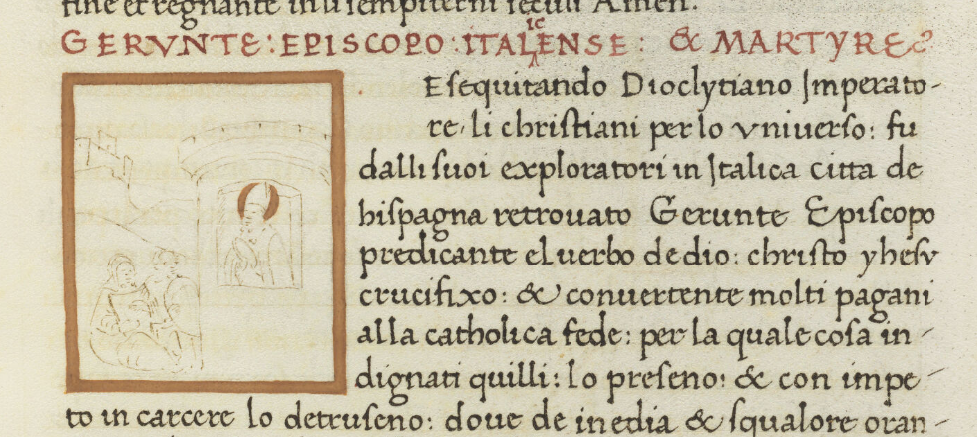
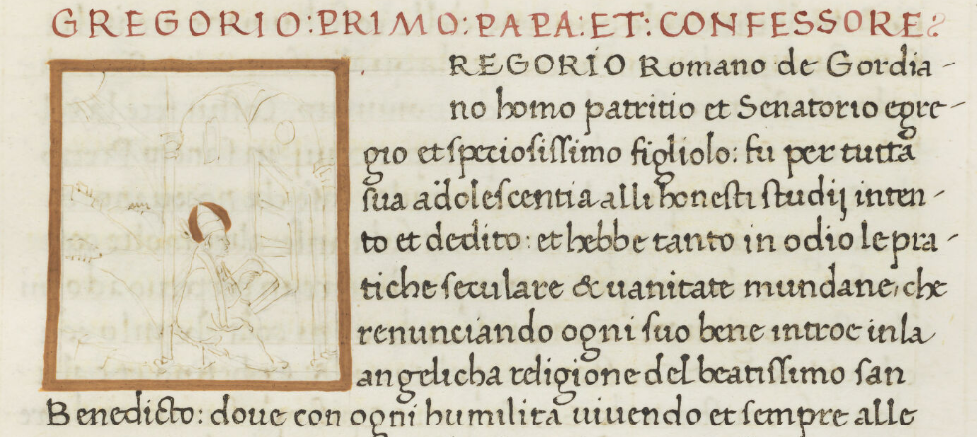
Continuing to look through the manuscript, we see that some spaces left open also have light drawings showing where the painting of the saint will go and how they will be depicted. The first example below shows the outlines of what will be Gerunte imprisoned with some guards or scouts outside the tower. The second detail is Pope Gregory I. Interestingly, for both of these drawings, we have a little bit of color already added. If none of the miniatures in this copy were colored more than this, then these would seem complete in a way since the drawing is detailed enough to understand and the frame is highlighted in orange. The saintly nature of the subject is also already depicted by the orange halo.
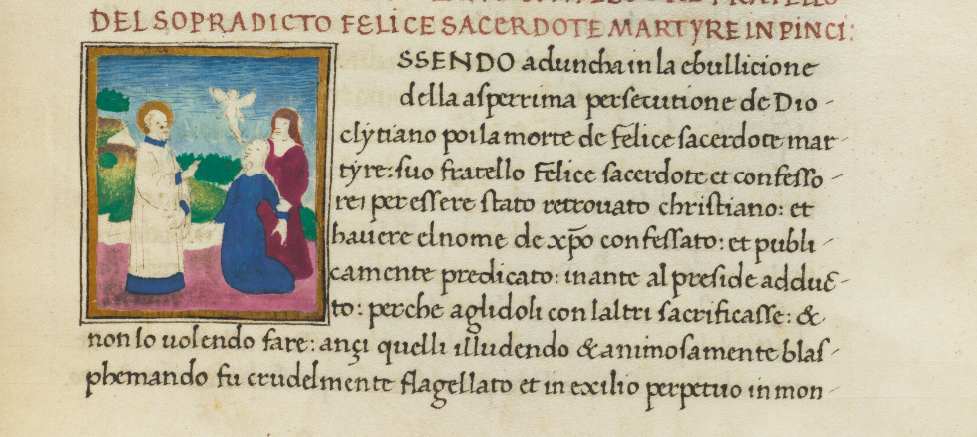
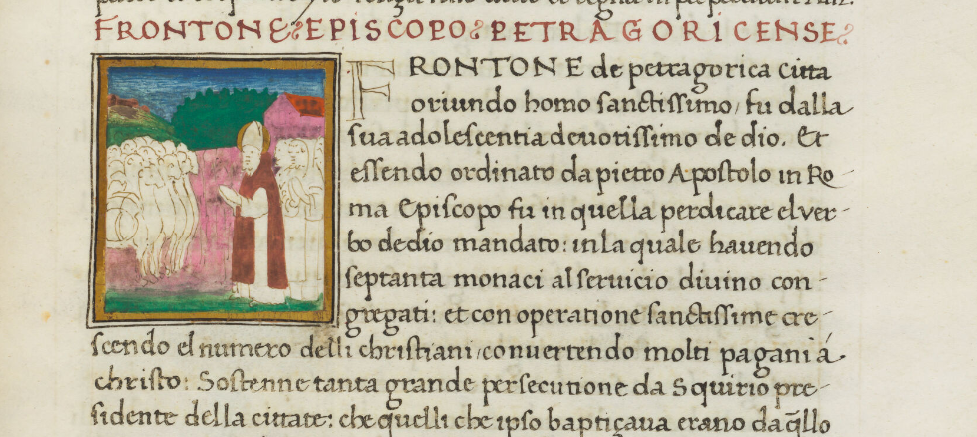
The next stage of completeness for these paintings are in the two examples below. In the first, the frame and halo are still present, but the characters are also now wearing colored clothes and the background is also colored. Some details of their faces, where the subjects overlap, and other details are not complete, however. Although it could be a choice to leave the characters’ faces unpainted since the features are drawn in, the untidiness of the areas around the blank spaces seems to indicate that these still need to be finished. Also, in example 1 below, of Saint Felix, we are also missing an initial letter that would have been two lines high. You can see the space for it just to the right of the miniature. In example 2, that initial is there (F), though it is not colored at all. The second example continues the trend of having the characters overlap a bit untidily with space left around them for edges to be added. The sheep in front and people standing behind Saint Front have also not been painted at all.
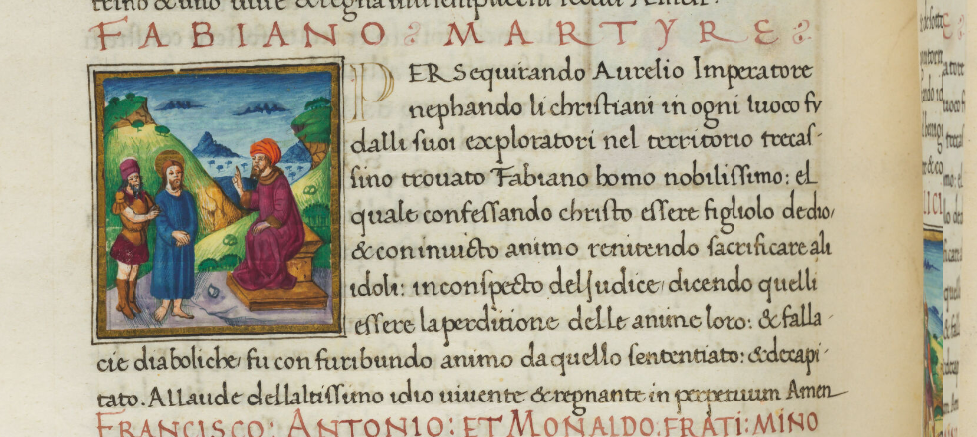
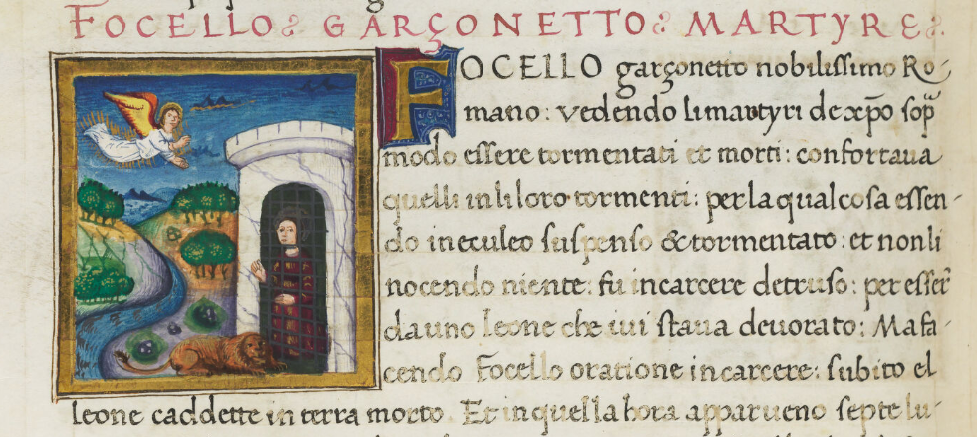
Finally, we arrive at the complete paintings. For these examples, below, we have Fabiano and Focello, both of whom have paintings in full color with some amount of detail. Notice that the initial letter for the paragraph about Focello is complete, but the the one for Fabian is just a sketch of the P and has yet to be colored or embellished. Throughout this whole manuscript, the level of completeness varies leaf by leaf and there is not, to me, an obvious reason why some images are complete and others are not, likewise for the initials and other decorations. As with many items in DS, there is plenty of room to do more investigating and fill in details.
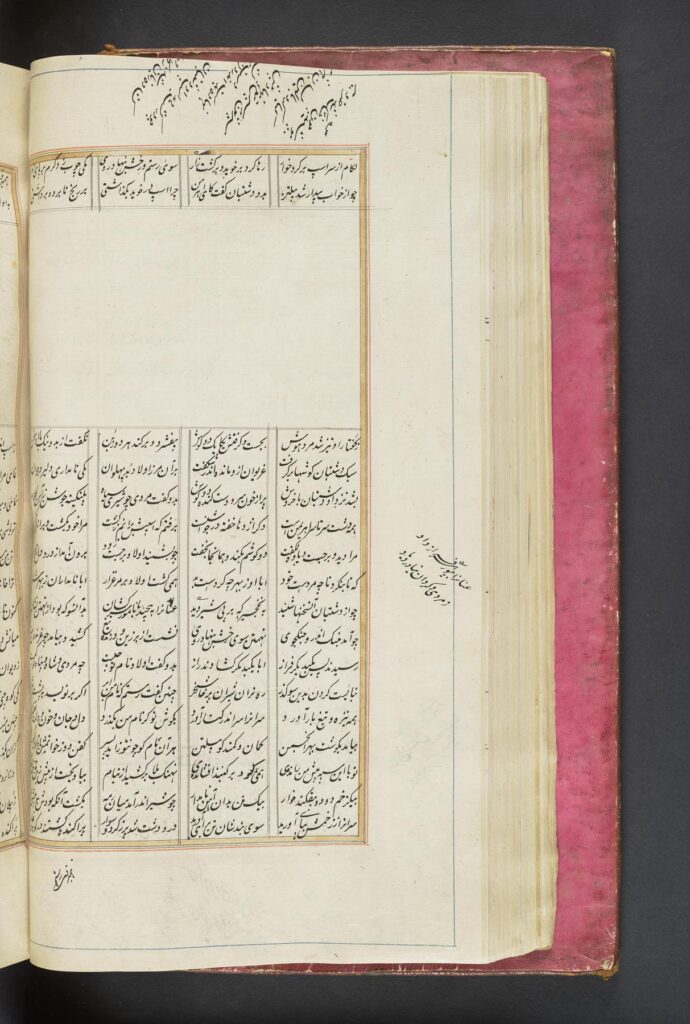
Let’s have a look now at a much later manuscript that also has paintings in various stages of completion. This is Bryn Mawr College BV 65, a 19th century illustrated copy of the Shahnameh. The images are hosted on OPenn. This copy is missing many planned illustrations and they are easily identifiable because of the large spaces left for them. An example is below.
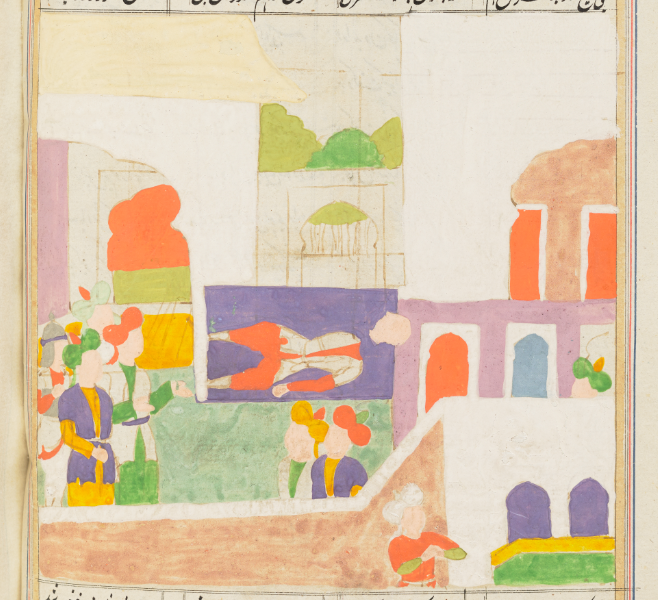
As with the Italian manuscript that we looked at above, this Indian manuscript also shows preliminary drawings and paintings in the intermediate stage. In the example below, you can see some of the drawing and background painting for architectural elements. There are also characters populating the scene who have been painted in a preliminary way so you can see where they will be, but with none of the detail of a completed painting.
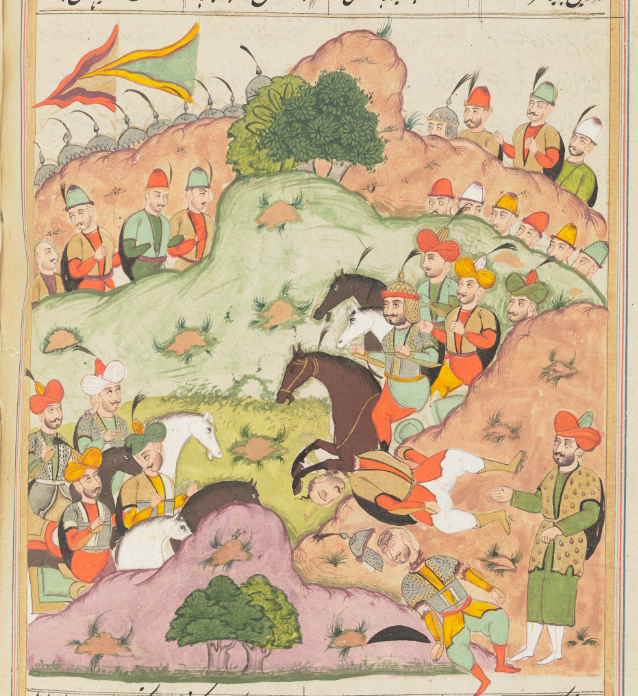
Below is an example of a finished painting that appears on the leaf after the preliminary one above. Here, you can see a scene from a battle, with flags in the background, detailed leaves on the trees, soldiers fighting and dying, decorations on clothing, expressions on faces.
There are many battle scenes depicted in the Shahnameh, so this manuscript has some that are partially complete and some that are fully complete and some that are left out entirely. Compare the example below with the one above. You can see the outlines of the same type of characters and background letting you know what the scene is in general, but they haven’t been detailed yet.
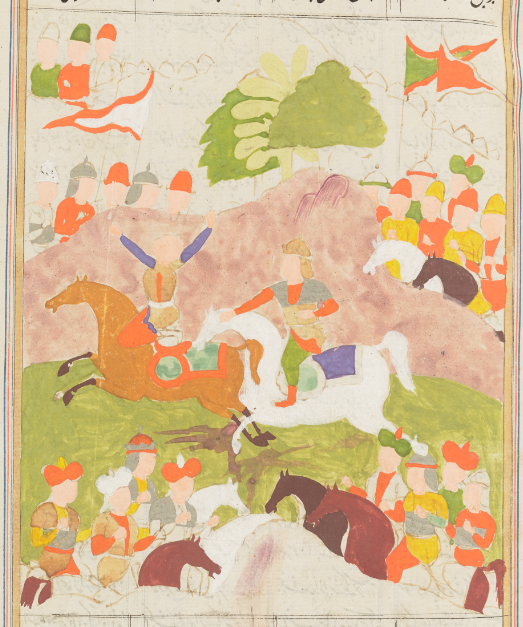
Again, similar to the Italian manuscript that we looked at first, there does not seem to be a clear reason for which paintings have been completed and which partially done or not started at all. The different levels of completeness are scattered through the entire manuscript. It is fun to scroll through the images on OPenn and just see what you see in terms of details. Sometimes a painting will appear quite complete, but as you look more closely, you notice details missing, such as architectural decoration or lines on turbans or tufts to indicate grass. My favorite type of incomplete painting in this manuscript is the one below, however, because this, to me, also reflects how DS is developing.
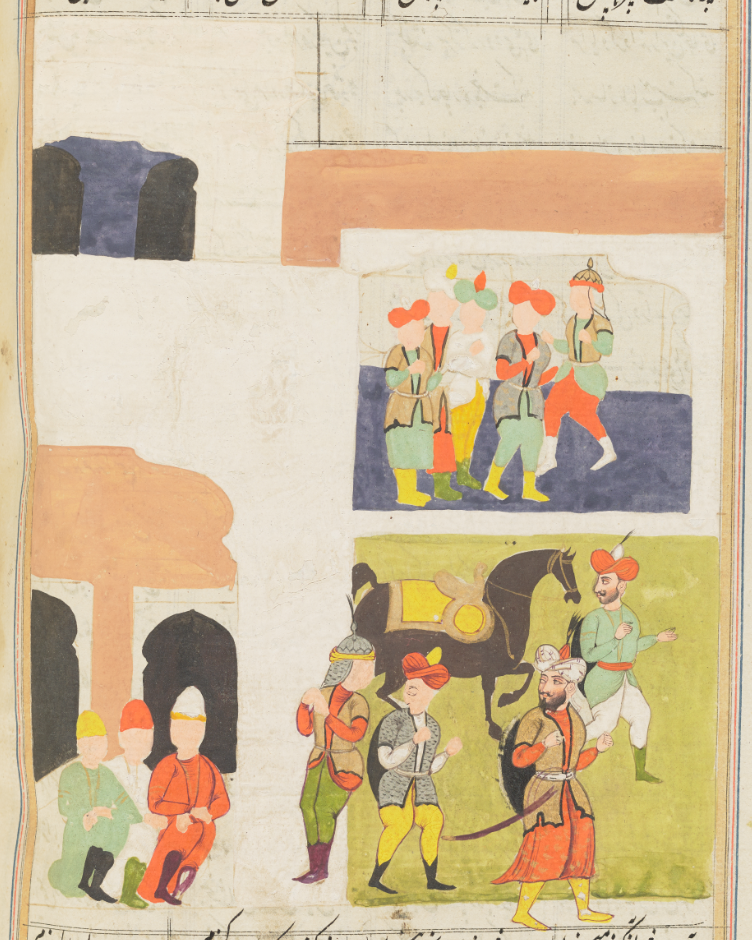
As with all the unfinished paintings, we have indistinct outlines and a variety of colors. At the same time there is one detailed and complete character and a couple others well on their way. This is how I see Digital Scriptorium. It is built and we know what it is. Collectively we work on refining definition and filling in details.
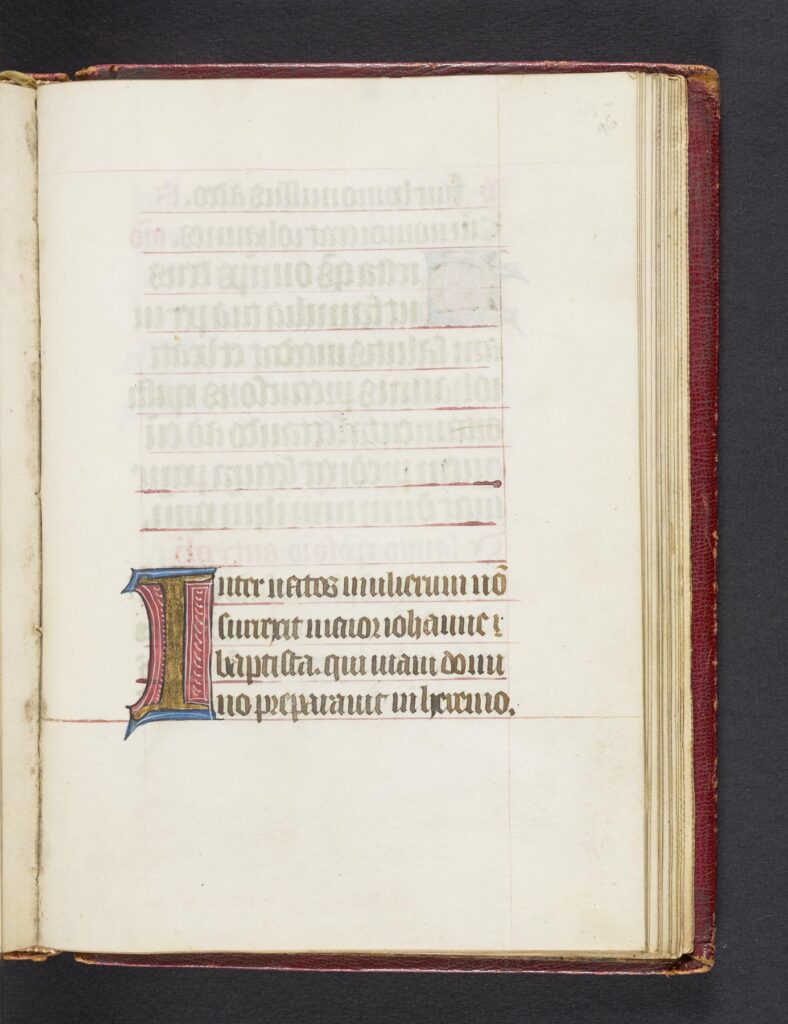
Before we end for this month, let’s look at University of Pennsylvania Ms. Codex 2030, which is a book of hours. You can see the images in DS or on OPenn. As you page or scroll through this one, you will undoubtedly see the blank spaces where paintings should have been added and were not. The initials and other decorative elements seem to be mostly complete in this copy, but the images are worth a second look. Below is an example of a blank space for an illustration along with a completed illustration so you can see how they are situated on the page and where the decorative elements in addition to the initial would go.
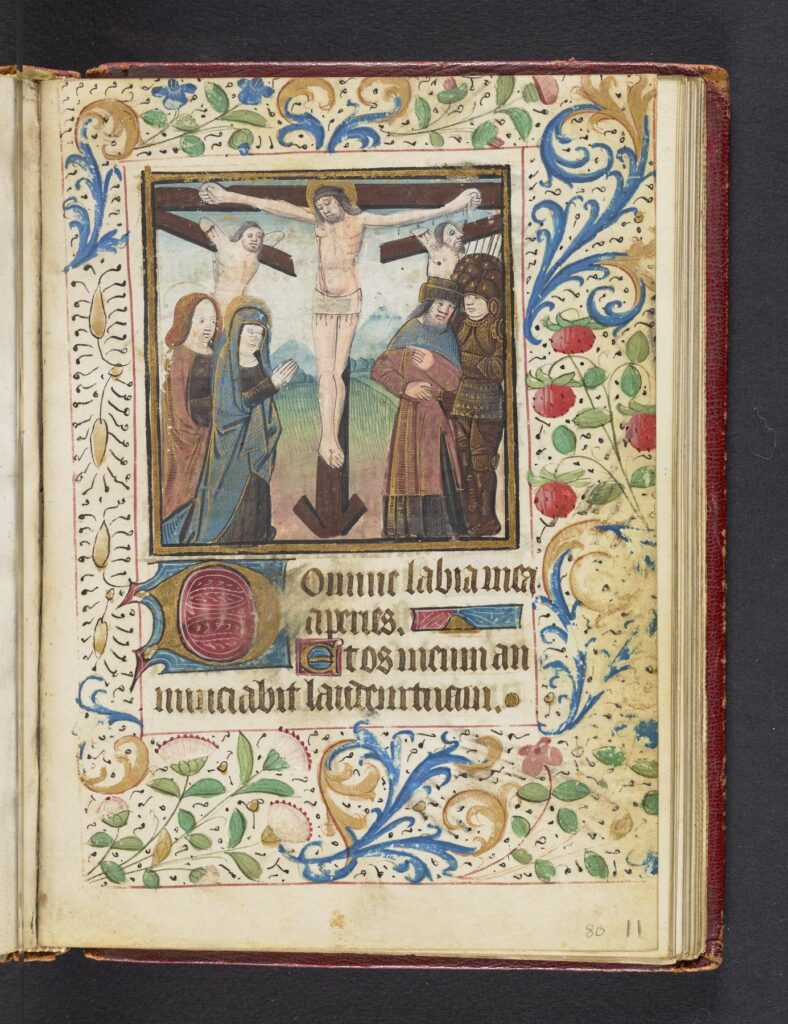
Now let’s compare to the complete image above what at first seem to be underdrawings, such as we saw in the Italian copy. Details of two such examples from this manuscript are below.
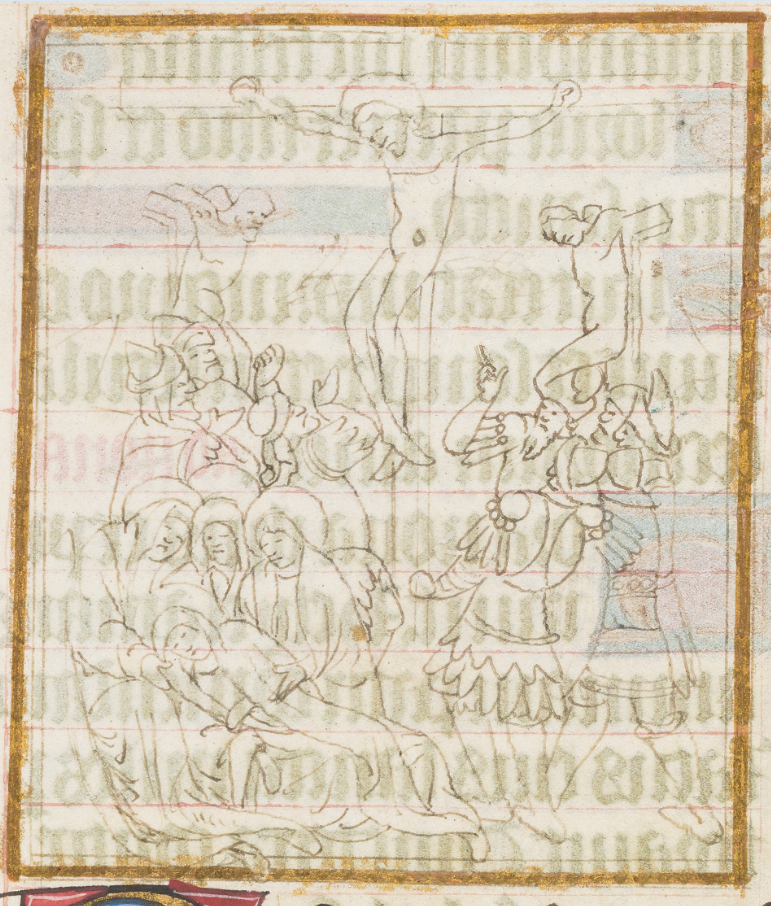
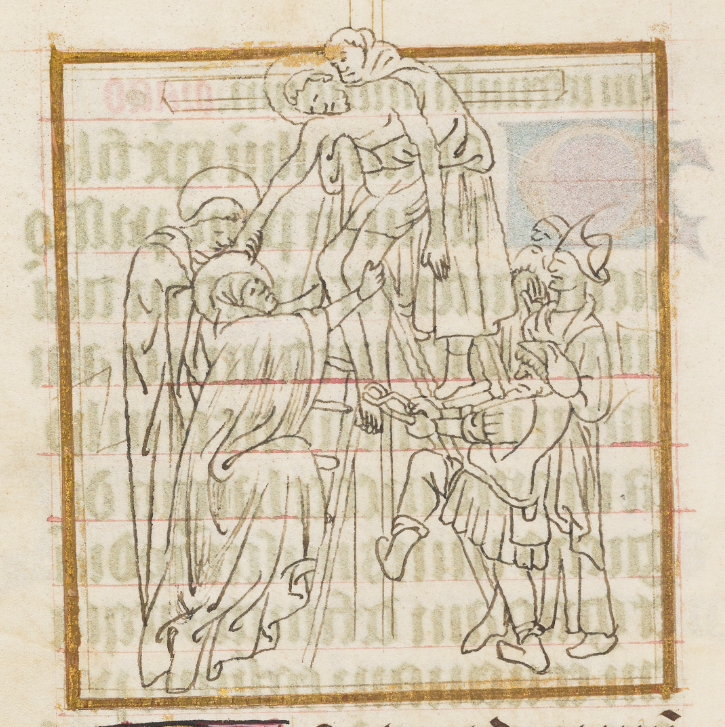
If we think back to the underdrawings of the Italian manuscript, it is evident that those drawings were stylistically in line with the finished paintings, as were the preliminary versions and the finished versions of the paintings in the Indian copy of the Shahnameh. However, these drawings are different. The style is different, the number of characters in each scene, their poses, and their clothing are quite different. In addition, there are five of these drawings and they are grouped together in the Hours of the Cross section, whereas the other completed images and blanks are more distributed. This difference in style and the more uniform placement prompts the questions of how they got there and when and why? According to the sale records for this manuscript, these drawings were already present in the 19th century, so they appeared sometime before that, but after the other paintings were completed.
I’ll leave you with that to ponder as we are thinking about works in progress and the kind of details that might begin to come to light when collections are made more available.