
Posted June 29, 2026 by Kelly Tuttle, Manuscript Data Curation Fellow
Recently, a manuscript copy of al-Ḥarīrī’s Maqāmāt from Union College in Schenectady, New York came to DS for cataloging. The first thing I noticed about it when I flipped quickly through the digital surrogate is that it has audition certificates in it, which is not something that I get to see very often in collections with which I’ve worked in the US. So this month, I thought it might be fun to look at this manuscript together.
Before we dig in, let’s get a little background on the genre of maqāmah (pl. maqāmāt) and on audition certificates.
First, the maqāmah. This is a genre that developed in the 10th century in Arabic literature with Badīʿ al-Zamān al-Hamadhānī (d. 398/1008). It is generally characterized by the use of rhyming and rhythmic prose (called sajʻ) interspersed with poetry, often containing a mixture of funny and serious anecdotes, and recounting the tales of “a hero…whose adventures and eloquent speeches are related by a narrator…to the author who, in turn, conveys them to his readers” (Encyclopedia of Islam, “Maḳāma”). In other words, it has a double framing technique. It is also a genre that lends itself well to linguistic acrobatics. Ḥarīrī (d. 516/1122), whose maqāmāt are recorded in the codex we will look at, does this with quite a bit of flair. The work, difficult to understand and translate though it is, has nonetheless been translated several times and an English version that tries to preserve the vibe of the Arabic was published in 2020, if you want to read it. Ḥarīrī’s collection of 50 maqāmah became renowned right away with its first publication and has remained the most famous collection of maqāmāt in Arabic. A few early manuscript copies of the text are extant and we have accounts of many more having been produced.
Second, audition certificates. These are a way of validating someone’s knowledge of a text. The Audition Certificates Platform (ACP) digital project, defines them as:
[N]otes written on a book to document the authorised transmission of the book’s text from teacher(s) to student(s). In concrete terms, the text was read out aloud (by the teacher or one of the students) and at the end of the reading session one of the members of this reading group added the audition certificate to the book. By virtue of their participation, all students now had the right to act as teacher in future reading sessions.
Since all people present at a session had the right to transmit the knowledge, all of their names are listed on the certificate (and not just free men; women and children are also listed as are enslaved people who were present).These certificates also list the chain of people from whom the version of the text was transmitted since the author is not necessarily reading, or present, or even alive anymore on the date the listening/reading session took place. Sometimes manuscript copyists would copy a certificate written into a source manuscript they worked from because it lent a little more legitimacy to the accuracy of their own copy. If the source manuscript had been used and approved in previous listening/reading sessions, then it was a good copy. Of course that does not stop a copyist from introducing errors as they copy; it just shows a kind of pedigree for the copy. The Union College manuscript we will look at contains several copied certificates as well as some originals.
Now let’s turn to the manuscript. I encourage you to open the digital copy in another window and flip around in it as you read.
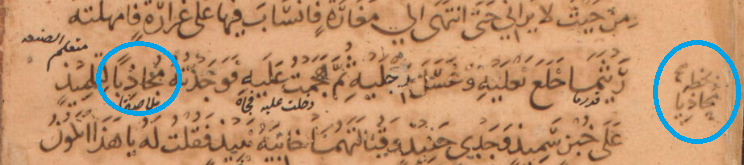
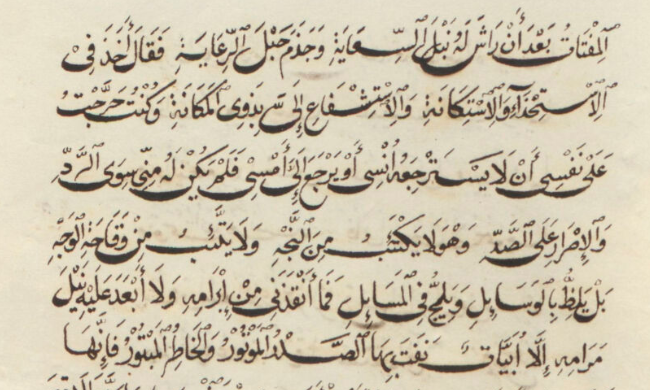
The first thing you probably noticed is that it has no covers. It is simply a textblock with remnants of paper hinges holding the pages together. There is also a repair to a tear on the first leaf that covers some notes on the front of the first leaf and lines of text on the back. We will come back to the notes at the beginning and end, which are the audition certificates. Let’s first look at the text itself. It is written in an extremely clear naskh script with all the vowels (and generally without the upper stroke on the letter kāf). A number of marginal notes appear throughout the beginning. The comments are largely glossing the vocabulary or explaining the meaning since, as mentioned above, this text is quite difficult to understand, even if you know Arabic well. These glosses and comments disappear suddenly at the end of page 15 (16 in the digital copy), which is the first page of the third maqāmah. Perhaps the students decided it was too much work adding in explanatory notes for every other phrase, or they decided to take their notes outside of the manuscript. The marginalia are not all uniform. There is variation in pens and hands. Some items are comments from the copyist (see below), some are later interpolations, and a few seem to be a much later learner of Arabic copying out lines of poetry. The scribal comments are found throughout the entire copy, but other reader comments are more isolated to particular sections.
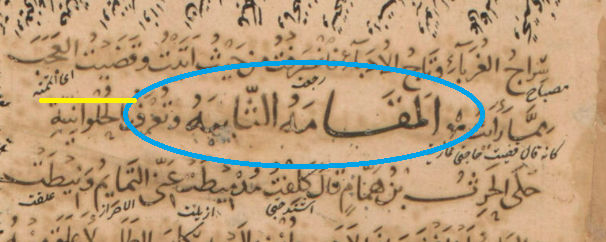
Another layout feature you will probably notice is the appearance of larger text that indicates the beginning of a new maqāmah (see below). Beginnings are often set off by larger text and not by starting a new page. Here, you can see that the next maqāmah (the second maqāmah in this example) continues directly from the end of the first one but with a slight larger script for the numbered heading (blue oval). The other title for this maqāmah (“al-Ḥalwānīyah”) is in small text following that (yellow overline). The numbered titles in the larger script make it easy to page around looking for a specific maqāmah.
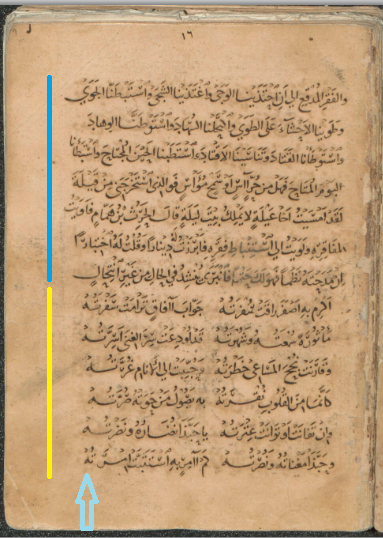
A second layout feature that you may notice is the way poetry is laid out compared to prose. There is quite a bit of poetry included in this set of maqāmāt and a good example of the visual difference is on page 16 (17 in the digital version). The top part of the page is prose and the lower part is poetry in two columns. Sometimes, especially if the poetry is just one or two lines, it is not as easy to see because it may be worked into the block of text a little more, but here you can easily see the difference.
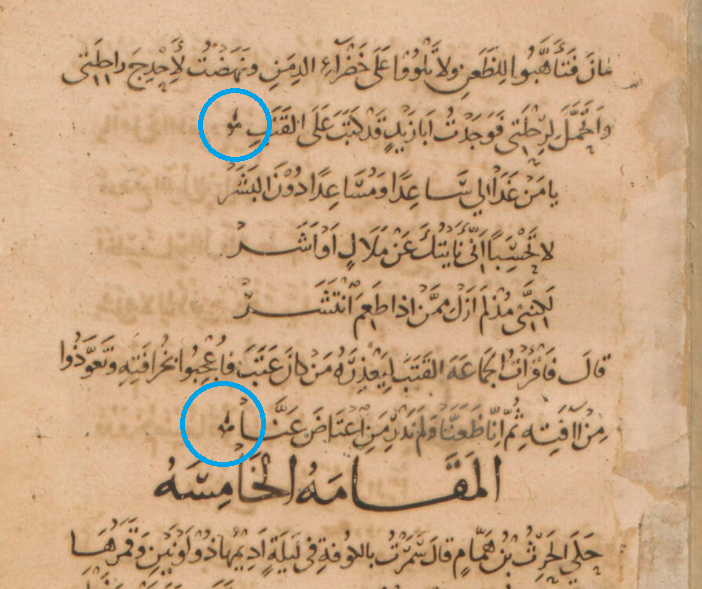
As you continue to page through, you will see these same items repeated over and over. A heading for each new maqāmah and poetry (in both two and four columns) interspersed with prose. One other notation you may notice is the little ending marker that looks like a tiny plant. It is not present at every ending, but it can often be found. A detail is below.
The next thing you will likely notice as you flip through this copy is the sudden change in paper and hand that occurs on page 78. The color change in the paper is enough to indicate that these lighter leaves are likely a later addition to supply a missing section of the text, but the handwriting changes as well, which affirms this. If you were to look at this copy in person and not just digitally, then you would also notice that the darker paper is a heavier weight and quite smooth. The lighter color paper is also lighter weight and is a watermarked European paper. Looking at the hands and script, the headings remain in thuluth script (the larger script), but the body changes to at least two different hands. It seems a set of replacement pages was made and then a few were lost and re-replaced by a third hand (see below). Since the replacement pages are ripped in some places, you can see quite easily the color difference between the original and some of the replacement pages in the photographs. Two examples are below.
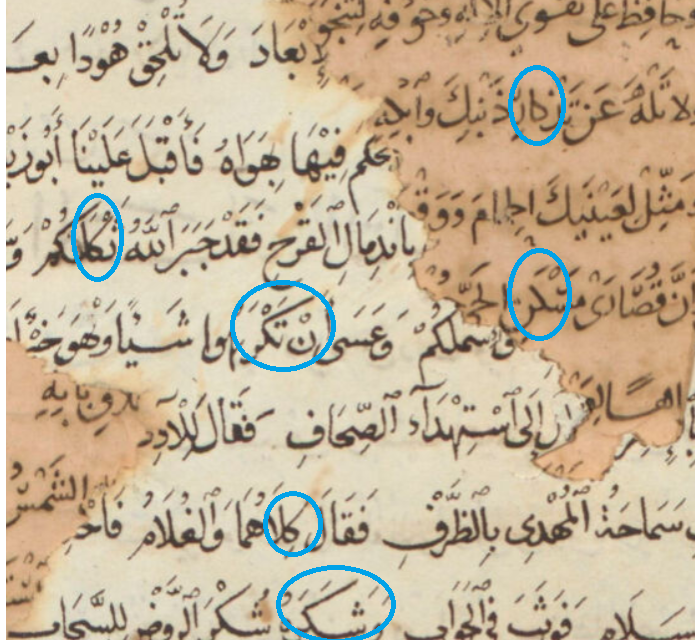
As you carry on turning pages, you may notice that the page numbers in the top center have disappeared, but the folio numbers in the top left are still there, though they are trimmed in many instances. Around this area of replacement leaves and rips, some leaves of the text are still missing and some of the leaves are out of order as well. The occasional comment in English in pencil was an earlier attempt to identify where the text jumps or is out of order. You may also notice that the copyist’s notes in the margins continue, mostly indicating where a variant word appeared, but the other marginalia has largely disappeared by this point.
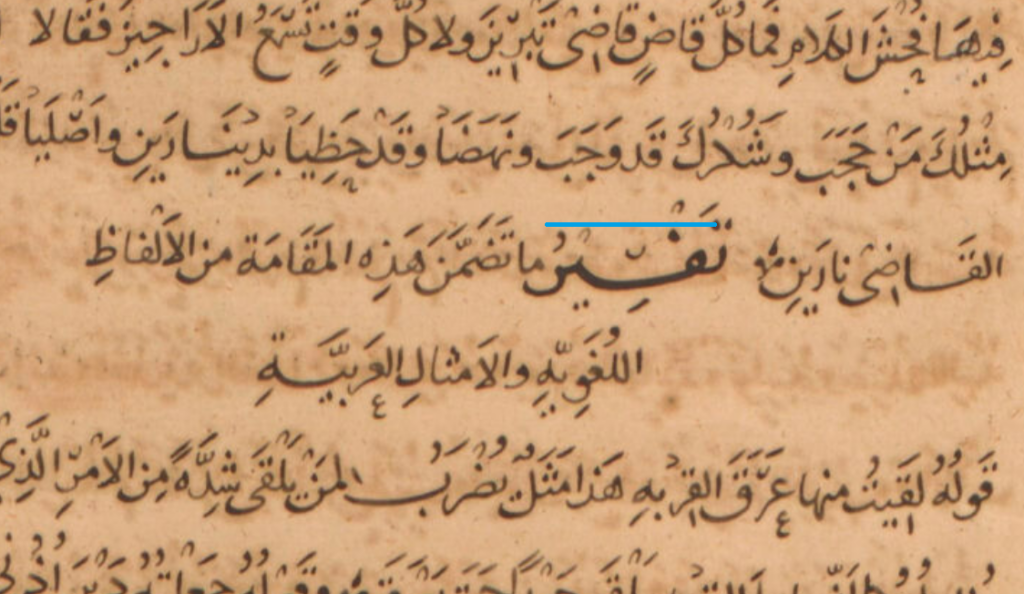
One other place where we will occasionally see headers in this copy is before the explanation or asides that the author gave during a reading that were then copied into the main text. You can see an example on page 253 (right side) of the digital copy (if using two-up view). The word tafsīr appears in the larger, header script to indicate that something new is happening. In this case, it is a linguistic explanation that is an aside from the maqāmah in which it appears.
When we reach the end of the fiftieth maqāmah and then the end of the conclusion, we still see text on the pages. These are the audition certificates. There are at least eight of them dated between 504/1111 and 663/1264 at the front and the back of the manuscript copy. The first three directly after the end of the text are copies of certificates that were on the manuscript the copyist, Muḥammad ibn ʻAlī al-Naqqāsh, was using as reference. In the margin before the note he writes, “Writing of what was on the original for this copy” meaning that he copied the audition certificate. Similarly for the next two, he says, “And I also found this, which I copied” before each one. That means that al-Naqqāsh copied this manuscript after 603/1207, which is the date of the latest of the certificates he copied.
If you are looking at the two-up digital view of these leaves, you’ll notice that the paper at the end is larger than the rest of the manuscript. We know the manuscript was trimmed at some point since some marginalia and folio markers are trimmed, but the last folios are significantly larger. At the same time, it appears to be the original copyist who copied the first of the audition certificates, which run onto the following, larger page, so perhaps he added extra leaves that were larger in order to have room for the certificates. Incidentally, the certificates that al-Naqqāsh copied also appear in the earliest known copy of this work, MS. Cairo Adab 105, which is dated 504/1111, the same year the work was completed and made public. That does not mean he was necessarily looking at that exact manuscript copy, but he had one which had the same certificates in it (see MacKay, “Certificates of Transmission”, specifically Certificates A, I, T).
Other certificates follow, but the hands look different and the ink has changed to brown. The next one (bottom of p. 337), which is also a copy (“Certificate M” in MacKay), is dated 563/1168 and seems to have been added to establish the authority of ‘Abd al-Laṭīf al-Baghdādī (d. 629/1231) as transmitter (even though he would have been very young at that reading session), who then reappears in the next few certificates. The next certificate, which takes the whole of page 338 says that Ṣadr al-Dīn Yūsuf ibn ‘Alī ibn Zayd al-Zuhrī is the reader making the copy. The reading for that one took place in Aleppo over several sessions, the last of which was in Muḥarram 627. This same Ṣadr al-Dīn is also found in the ACP where he is listed as being present at a reading in 604 in Damascus.
Let’s look at one more short example of how these audition certificates link to one another. The remaining three certificates on pages 1, 339 and 340 all list Badr al-Dīn Muḥammad ibn Ibrāhīm ibn Khallikān as one of the linking people. On page 339, dated 655, he is present, along with his brother, Shihāb al-Din, as representatives in a chain for one of the recensions listed for which Aḥmad ibn Muḥammad ibn ʻAbd al-Munʻim ibn Abī Ghānim al-Ḥalabī is receiving an ijāzah (permission to teach) from Aḥmad ibn Muḥammad ibn al-Khiḍr al-Ḥalabī (d. 658/1259). In another (p. 340), dated 663, Badr al-Din is now the one giving the ijāzah and, after the reading, discussing other recensions of the text, which included the reading of Ibrāhīm ibn Yaḥyá al-Miknāsī (d. 666/1268). Then, on the first page of the manuscript is another note, in al-Miknāsī’s handwriting, that says Badr al-Din ibn Khallikan was the reader and that he, al-Miknāsī, collated his copy with the original. He then lists the rest of the recension back to Ḥarīrī. The date of the first note (p. 1) has been partially obscured by the tear and repair to the first leaf, but it probably predates or is the same time as the note at the very end where al-Miknāsī is again said to have collated his copy.
The certificates that appear on the end pages (pp. 338-340) and also on the front page of Union’s manuscript do not overlap with any listed on the ACP for copies of this work, but they do involve people who are listed in other certificates found there since that platform is strong for sessions that took place in Damascus and Aleppo. For example, the person who wrote up the certificate on p. 339 (dated 655), Aḥmad ibn Muḥammad ibn ʻAbd al-Munʻim ibn Abī Ghānim al-Ḥalabī, also appears in the ACP in two certificates dated 646 and 647 for other works, as a listener and as a reader.
Audition certificates are full of information, as the ACP project rightly points out. This brief review of just a few of the participants listed on this manuscript copy is barely scraping the surface and more research could be done and more connections made. Hopefully, having these items on DS will make them more easily findable to people who know more or want to learn more.
References
Aljoumani/Hirschler: Audition Certificates Platform (version 6), audition certificate Berlin State Library, Landberg 355, 14v, N. 3, ed. Said Aljoumani https://www.audition-certificates-platform.org/ac/2679, accessed June 20, 2026 (DOI: 10.25592/uhhfdm.17611).
Aljoumani/Hirschler: Audition Certificates Platform (version 6), audition certificate Berlin State Library, Wetzstein I 140, 167v, ed. Said Aljoumani https://www.audition-certificates-platform.org/ac/3384, accessed June 21, 2026 (DOI: 10.25592/uhhfdm.17611).
Aljoumani/Hirschler: Audition Certificates Platform (version 6), audition certificate Syrian National Library, 3771/10, 154r, N. 2, ed. Said Aljoumani, with contribution by عبد الله باوزير https://www.audition-certificates-platform.org/ac/4984, accessed June 21, 2026 (DOI: 10.25592/uhhfdm.17611).
Brockelmann, C., and Ch. Pellat. “Maḳāma”. In P. Bearman (ed.), Encyclopaedia of Islam New Edition Online (EI-2 English), (Brill, 2012) doi: https://doi-org.proxy.library.upenn.edu/10.1163/1573-3912_islam_COM_0634
MacKay, Pierre A. “Certificates of Transmission on a Manuscript of the Maqāmāt of Ḥarīrī (MS. Cairo, Adab 105).” Transactions of the American Philosophical Society 61, no. 4 (1971): 1–81. https://doi.org/10.2307/1006055.