
Posted August 27, 2026 by Kelly Tuttle, Manuscript Data Curation Fellow
One of the benefits of Digital Scriptorium membership are the Eureka grants that support “projects that will lead to innovative cataloging and digitization practices, the creation of new manuscript descriptions, the education and training of a new generation of librarians, curators, and scholars in the curation of digital manuscript data, and the dissemination of new research.” This summer, three projects are using the grants to accomplish different goals. One of them is Columbia University, which is using the grant to catalog and describe more of their uncataloged Islamicate manuscript collection. The process is being accomplished mostly through the efforts of two graduate students who are creating the preliminary records for the undescribed manuscripts and through that activity, learning more about the Columbia Islamicate manuscript collection and the work of special collections librarians and catalogers. As they have been working on the items, many of which are in Persian, the same stamp keeps appearing variously described as a customs stamp, a stamp with a title, a library stamp and just a stamp with no description. Since the stamp is so common and since it mostly seems to be dated to the year, 1312 Persian solar date (1933-34 CE), let’s look into it a bit more to find out what it is, exactly, and then see if any more examples of it could be found in DS.
As opposed to other stamps found in manuscripts, this stamp is almost always quite clear and easy to read. It is obviously a bureaucratic stamp, rather than a personal stamp, as it contains no personal or collection names. The layout is two concentric circles with four words around the space between the circles and two letters inside the smaller circle. It says مراجعه وتفتيش شد (murājaʿah va taftīsh shud [inspected and verified]) and then the word سنه (sanah [year]) with the number 13 above it with space to fill in the last two digits. In the center are the letters bā’ and tā’ (ب ت) stacked one atop the other. An example is below.
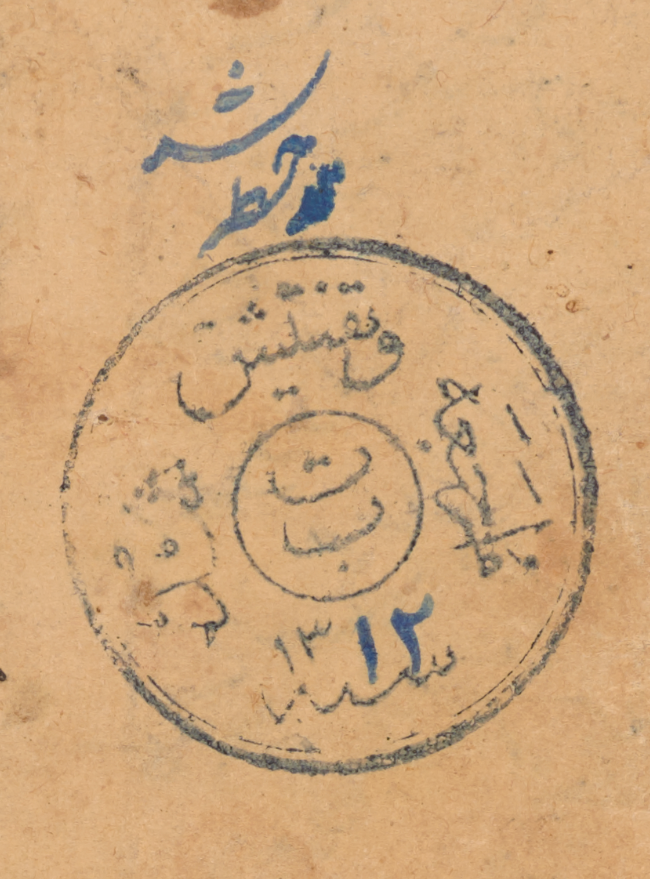
In records, the stamp is often called a customs stamp, since the wording on it does seem to conform to what would be added to a manuscript as it is prepared for export either right before or after sale. However, in the Columbia collection, almost all of the stamps bear the same year date, which seems odd if the stamp was added at export. It would mean that the entire collection of these items was purchased and exported in the same year. That seems unlikely since the items do not otherwise all have the same donor or provenance. It could be that all of the items were stamped together as to-be-sold, sort of like when your local library decides to sell old books or books that do not circulate well and stamps them all as ‘withdrawn’ or ‘discarded’.
I dug a little deeper and found reference to an example of the stamp on one of the earliest manuscript copies of the Divan of Hafez, which, as of 2021, was in the Golestān Palace Library in Iran. If you select the link above, you can just see the stamp in purple in the upper rightmost image (although the image is somewhat fuzzy, it is clearly the same stamp). There is also a paragraph describing what that stamp is doing there. It says that a circular stamp—indicating the item had been inspected and verified in the year 1306—appears on the opening pages of the manuscript and that the stamp dates to the discovery of a theft from Iran’s Royal Library during the tenure of the librarian Lesān-al-Dawla. In an attempt to figure out which manuscripts may have been stolen, government agencies inventoried their collections. After cross-referencing the manuscripts with the inventories held at the Golestan Palace and verifying their provenance, this stamp was affixed to the flyleaf of the beginning and end of the manuscript
Basically, an inventory was taken of the items in various collection so that anything missing could be flagged as missing and/or stolen. So, who was Lesān-al-Dawla?
According to Nasiri-Moghaddam in the Encyclopedia Iranica, Mirzā ʿAli Khan is his name and his career at the royal court began in Tabriz. In 1896, when Moẓaffar-al-Din succeeded Nāṣer-al-Din Shah, he accompanied the new Shah to Tehran, having been granted the title of Lesān-al-Dawla. He was made the librarian of the Golestān Palace and remained in this office until the Shah’s death in January 1907. He was later arrested several different times and accused of theft from the library. There were 150 manuscripts from the library found at his house, however, “because of insufficient documentary evidence, Lesān-al-Dawla was never officially brought to trial and sentenced”. He did, nevertheless, spend three years in prison over the course of the arrests, which took place between 1909 and 1917. The latest mentions of him in the Iranian National Archives are from July 1920, when he was issued a summons to appear at the public prosecutor’s office. He probably died not long after those summons, as he was in ill health.
Did this alleged theft really prompt the complete review and inventory of the royal collections? Probably not entirely. There were education and other reforms being undertaken during the same time period that likely contributed to the systematic review of library and archival holdings in the country. Another source that mentions this type of stamp gives the same account of the theft, but then also adds that the stamp was primarily applied to manuscripts whose owners sought to export them and it is accompanied sometimes by a note saying “export permitted” (Hakim, 2017, p. 69).
Since that is the case, it makes sense that items in collections outside of Iran would have this stamp. So far, most of the examples I have found have been in the Columbia collection, though I did find a few other examples in DS that we’ll look at below in order of date.
The earliest that I have found in DS is on an illustrated manuscript in the Free Library of Philadelphia, Lewis O 154A. This one has several of these stamps in purple all dated to 1305 (1926 CE). What is different about this one is that not only are the front and back flyleaves stamped, but all of the illustrations are also stamped. An example is below.
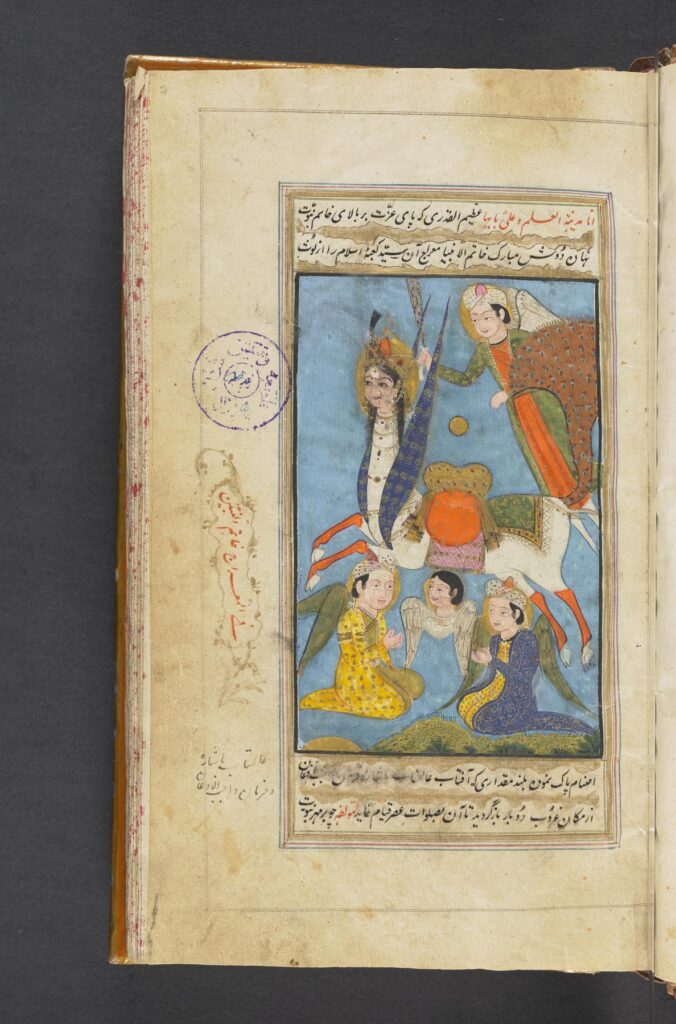
In the copy, there are 37 full page illustrations and all but nine have the purple stamp with the 05 of the date written in. I am not sure what the significance of stamping almost every illustration would be, especially since this copy is missing some illustrations (there are blank spaces left for them) and some of the illustrations escaped stamping. In any case this copy is quite thoroughly stamped, having about 30 stamps in it all saying the same thing.
The next set of stamps are those in Columbia’s collection. Of the items that I have seen, they are all dated 1312 (1933 CE) and there are about 50 items so far that have the stamp. The CE dates in the records currently in DS were mistakenly calculated reading these stamps as Hijri, and not Persian solar year, but that is something that can be fixed next time Columbia does an update. See a couple of examples below.
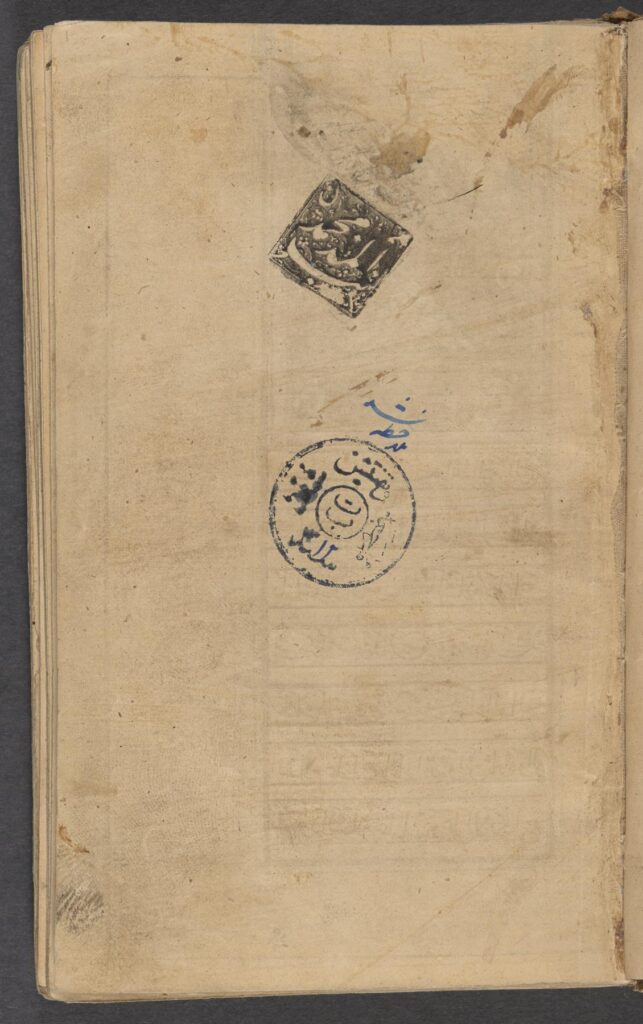
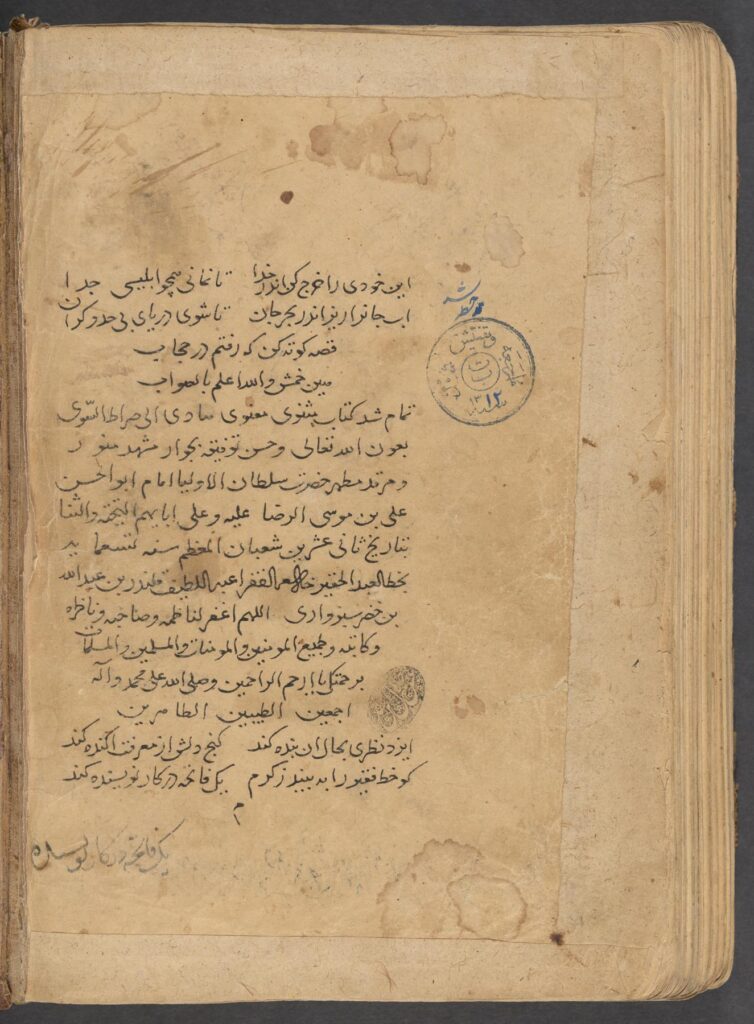
Two stamps from the Columbia collection, both having the same date.
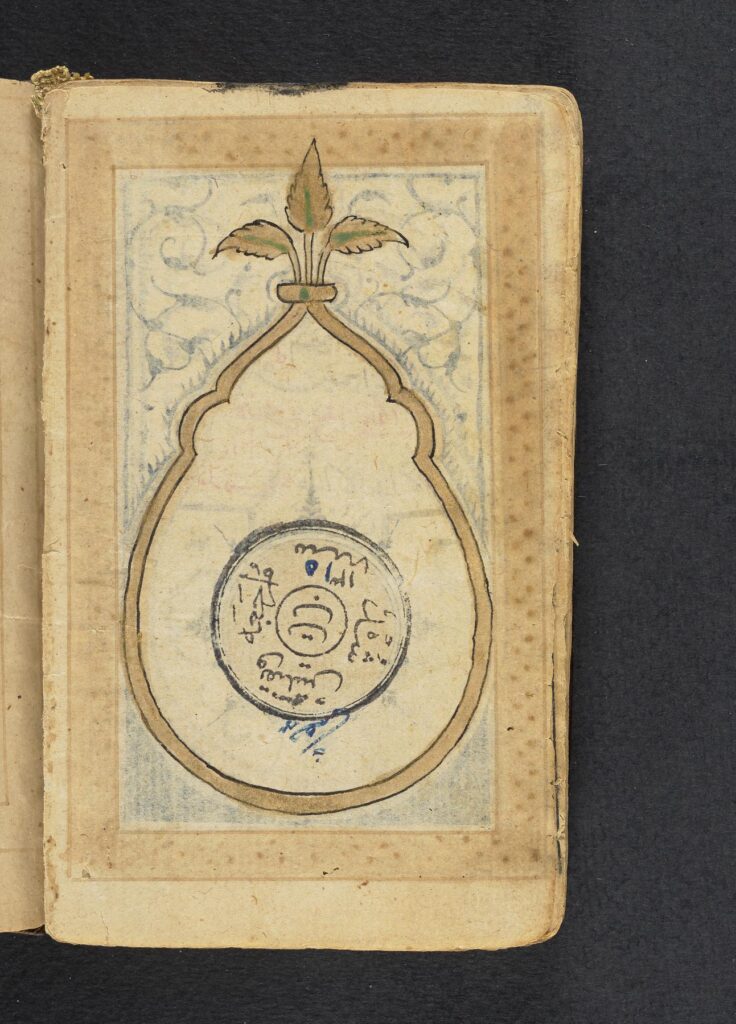
After that, we have an item from Bryn Mawr, BV 71, stamped 1315 (1936 CE). This one is in a devotional book where every page has a sort of pear outline on it to hold the text with decorated borders and sometimes painted backgrounds in the otherwise empty space between the pear and the rectangular page frame. The stamp, in this case, is on the first and one of the last folios. See the example below.
And finally, the latest entry to our little collection is an item at the University of Pennsylvania, LJS 189, which is a larger format item that has been completely remargined and has had some leaves replaced at the beginning (Reidel, 2022). In this case, the stamp was put on the first folio recto, where there were already other owner stamps, but it was stamped so darkly that it bled through to the verso side and is visible above where the text begins. See image below.
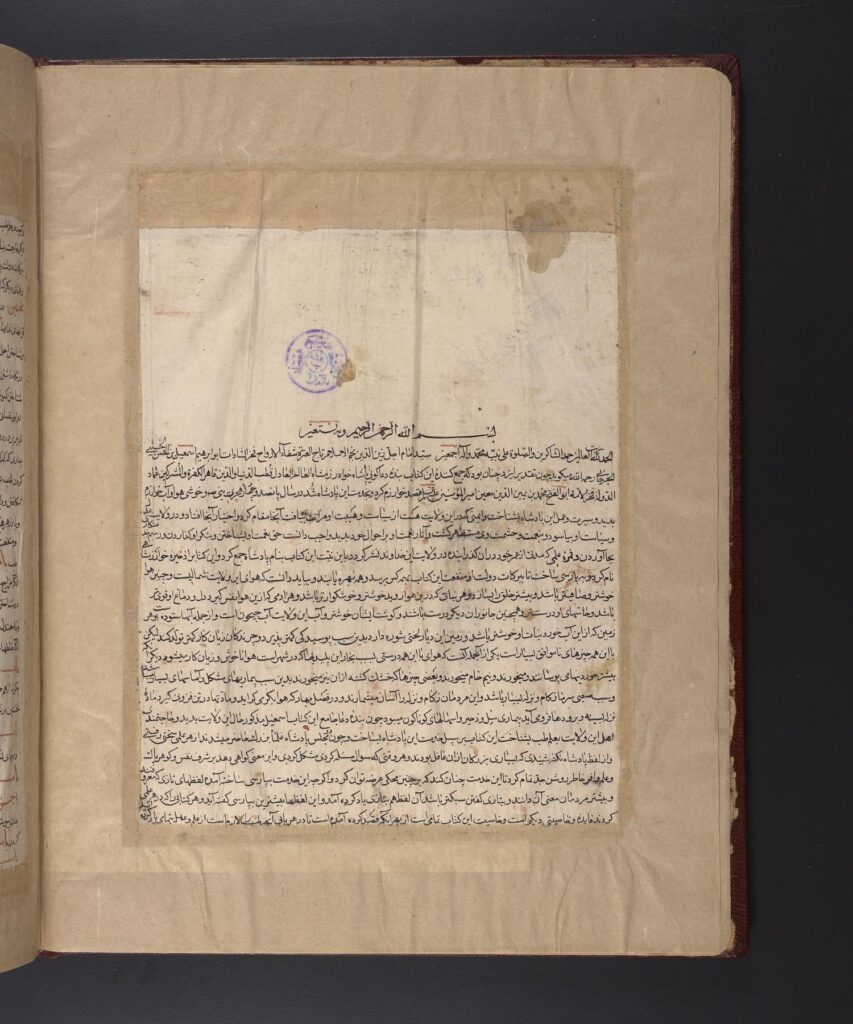
This one is dated 1342 (1963 CE), quite a bit later than the others, and for that reason seems like it is actually an export or purchased-for-export stamp. Looking at the provenance for this manuscript, it was offered for sale at auction at Sotheby’s (London) in a sale of property of the Hagop Kevorkian Fund on 2 May 1977, lot 163, but went unsold. It has been argued that the Hagop Kevorkian Fund acquired this manuscript in 1963 and exported it from Iran with the intent of selling it at auction in the UK or the US (Reidel, 2022). It did not sell in 1977, but it did sell in 1981 when it was put up for sale a second time.
In summary, these stamps appear to be inventory stamps that are also used as export stamps and they are dated with the Persian solar calendar date. They can be helpful in provenance research and as we continue working through the Columbia collection of to-be-cataloged items and items from other member institutions, we’ll keep an eye out for these and add them to the records.
References
- Nasiri-Moghaddam, Nader. “LESĀN-AL-DAWLA.” Encyclopaedia Iranica. Published April 7, 2008. https://doi.org/10.1163/2330-4804_EIRO_COM_386
- Blogpost, “نگهداری از نفیس ترین نسخ خطی و سنگی دیوان حافظ در سازمان اسناد و کتابخانه ملی ایران” October 12, 2021. Accessed August 8, 2026.
- Hakim, Mohammed Hossein. اوراق زرين = Awragh zarin. National Library and Archives of Iran. 1396 [2017], p. 69.
- Reidel, Dagmar A. “Repairs and Restorations as Evidence for the International Manuscript Trade.” Slide deck from presentation given in Berlin on 30 June 2022.