
Posted March 27, 2026 by Kelly Tuttle, Manuscript Data Curation Fellow
I was looking at digital images for items in DS and came across the image below.
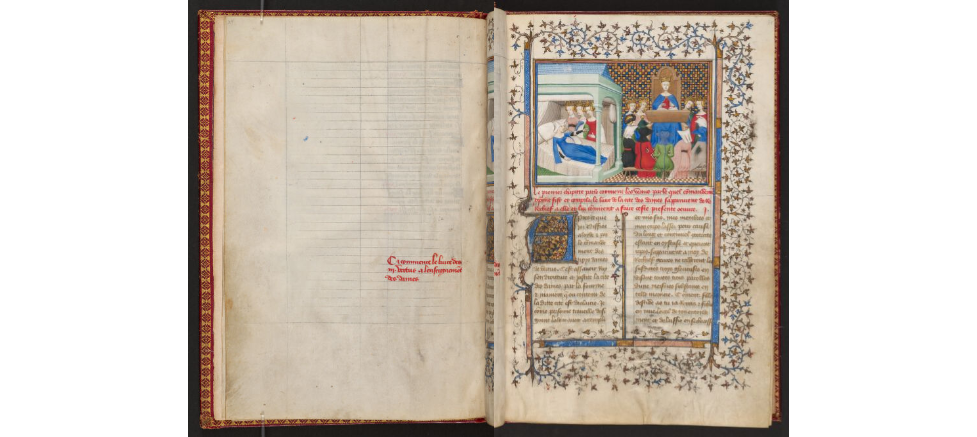
My immediate thought was, ‘Oh, this must not be finished’ because, to me, this page opening looks unbalanced with the illustration, illuminated borders and text on one side of the opening and only a small rubrication on the other. In addition, all those very clear ruling lines on a mostly blank page seem so lonely, like someone planned to fill them with text and then wasn’t able. It almost looks like the rules were so tempting that the rubricator went back through and added the note, “Here begins the book of The Three Virtues for the education of ladies” because the blank but ruled page just needed a little something.
Ruling lines to help guide writing appear in many manuscript traditions. So, as I like to do when I find something in DS, I went looking for comparable items within the catalog. I wanted to see in which other traditions we had visible examples of ruling lines already in the catalog.
I first tried a query looking for the term ‘rules (layout features)’ (Q38537), which is one way that a cataloger may list whether they saw ruling lines on the text. The drawback is that many catalog entries do not include this term, even if rules are present, and others use it only for ink lines around the text box and not rules for writing. In any case, this query only returned items belonging to one institution and was therefore not very useful. I then decided to do simple searches for ‘ruled’, ‘ruling’ ‘dry point’, ‘ruling board’ and related terms to see what came up. Those searches worked fairly well. I had first filtered by presence of digital surrogate, so I was only getting results that had images and then filtered those results (image + term) by language one at a time to see what I could see in the images. Let’s have a look. We’ll start with examples that are similar to what we saw in the first image.
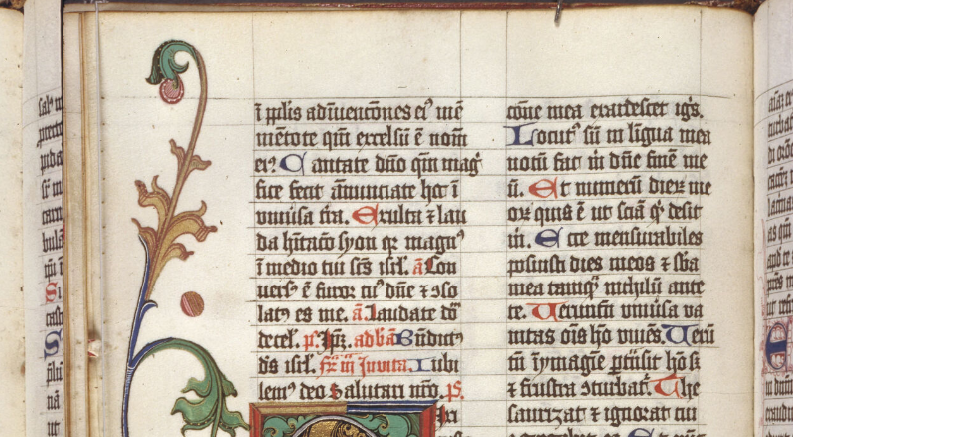
This is MS Richardson 39 from Harvard University. In the image below, you can see the ruling lines very clearly in quite a dark ink, running in parallel down the middle, along the outer edges of the text area and above and below each line of text. You can also see the pricking, small holes punched along the edge of a leaf to guide the rules, running down the left-hand side of the leaf, near the outer edge. Pricking can be seen on European manuscripts and some from other traditions as well.
A similar example can be seen in an Ethiopian manuscript from Princeton University, Princeton Ethiopic Manuscript No. 11, detail below.
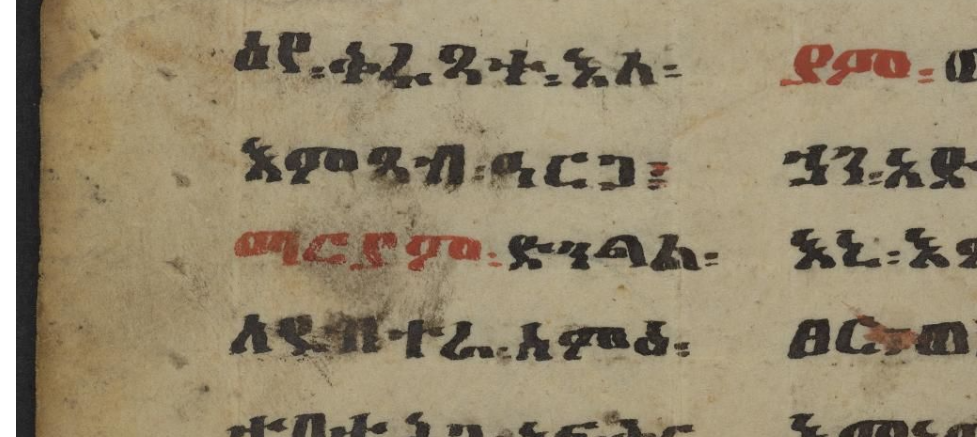
In this example, you may notice the small marks down the left side aligned with the lower edge of each line of text. If you zoom in very close on the digital image in the record you will see that rather than ink marks, these are in fact tiny, horizontal cuts in the parchment made by a knife point rather than an awl-type instrument as in the preceding example. On this leaf, you can also see an uninked ruling line running vertically along the left edge of the left column. Elsewhere in this manuscript, however, the rules are in a light gray color and easier to see.
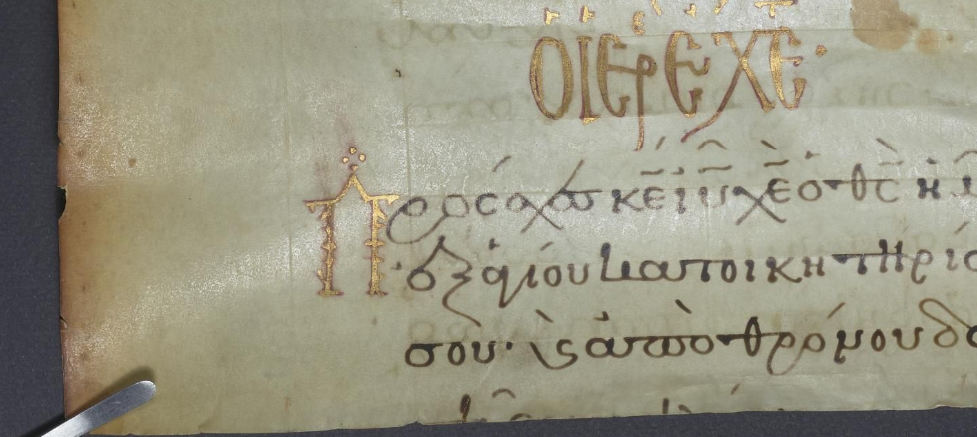
One last example, on a parchment roll manuscript in Greek, will let us see more pricking and also rules in drypoint. Below is a detail from University of Pennsylvania Ms. Roll 2062. Since this is a parchment roll, it was not perfectly flat when it was photographed. We therefore get a nice reflection of light on the drypoint rules in the image. You can see that they have a texture that is different from the surface of the parchment. If you look where the light reflects, the rules and their texture become more obvious. The pricking, down the left side of the image, is more difficult to see, but you can probably tell how the slightly darker dots where the punctures are located align with the rules.
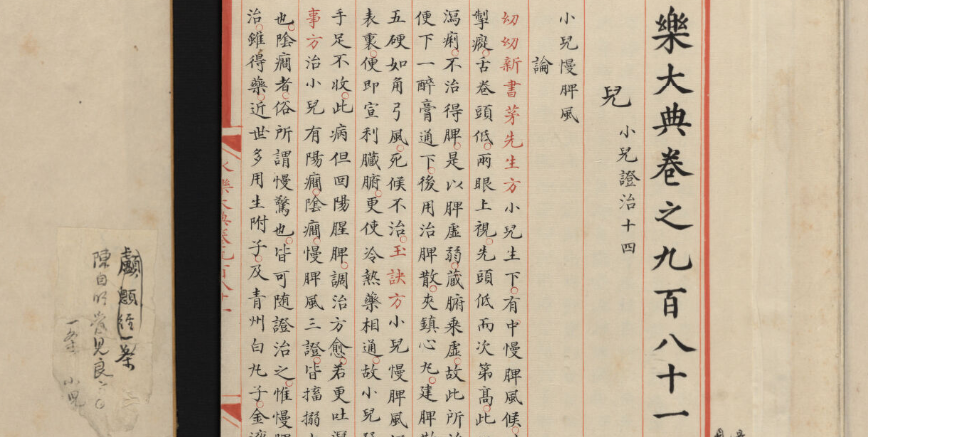
Next, let’s look at examples from Chinese and Japanese. For the ruling lines in these items, we find both ink and blind (uncolored or uninked) examples. Below, from Harvard University Ms Chinese 6, you can see the red ink rules running vertically to separate every two lines. These rules look like they are supposed to be part of the copy design and not merely a grid to keep everything tidy since they are in a red that is similar to the red frame around the edges and the rubrications. They also meet quite neatly at each corner and intersection with few line ends extending beyond the intersection.
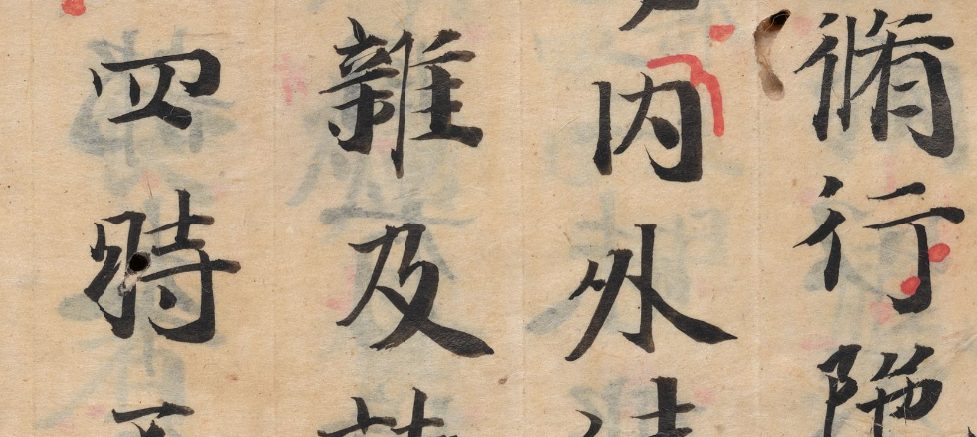
We find blind vertical rules in other examples. Below is a detail from Princeton University BQ1873.J3 T75 1118. This text is written in seven lines on each page and in this detail, you can see four of the blind rules running vertically between the lines. They are clearest after the first and second columns from the right side.
If you would like to see an example leaf in Japanese with blind, vertical rules, have a look at Saint Louis University VFL MS 050.
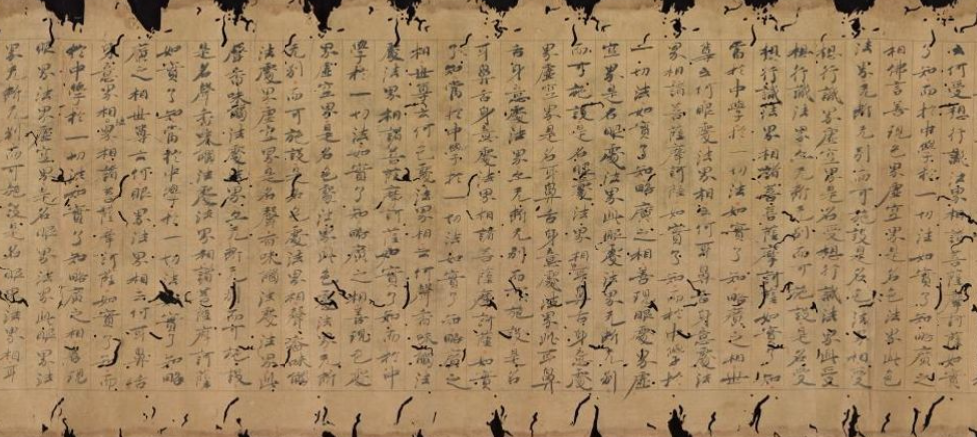
One final example, a scroll from Princeton, shows vertical rules and a frame-rule around the edge. This time the rules are inked in a very light black. Below is a detail. You can view the whole scroll BQ 1100 T67 in the DS catalog. Zoom in to get a closer look at the rules, the layout, and also the worm damage.
If you opened any of the records linked above, you probably noticed the minimal descriptions that accompany these items. This means, of course, that there is much more research that could be done into these holdings. As with any record you see in DS, if you have more information about that item, contact the holding institution and let them know. They can update their records and then the DS catalog.
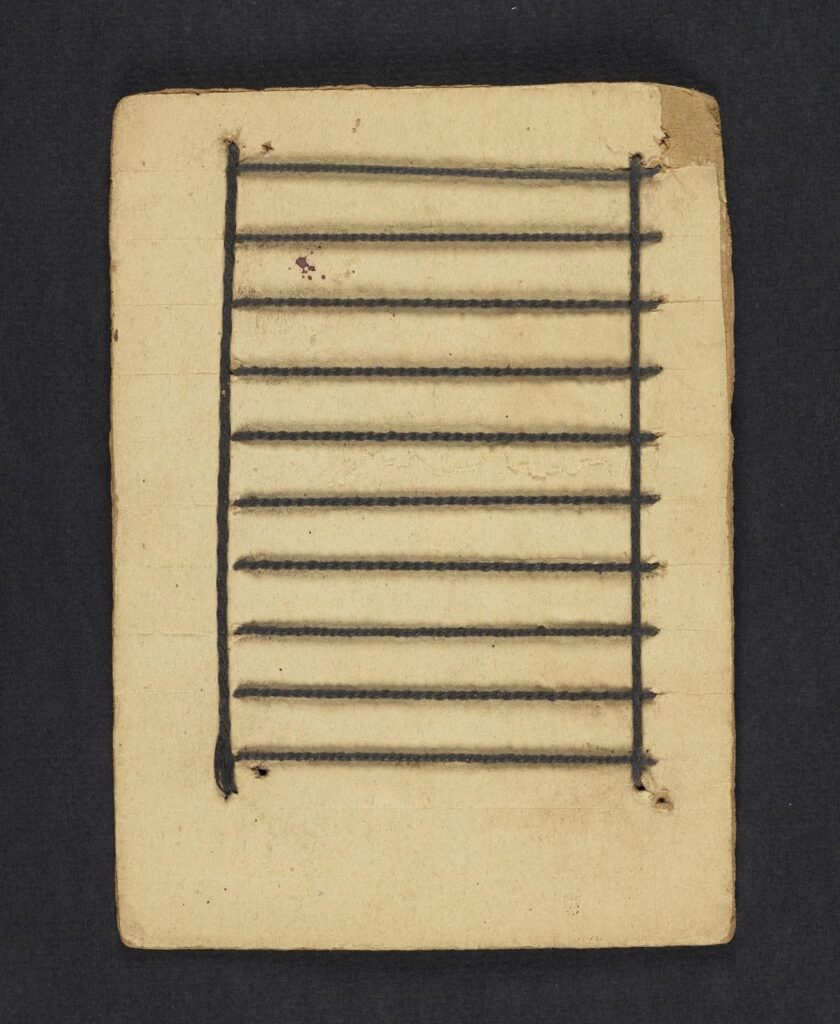
Let’s turn to one more set of examples for which we have records in DS. In the Islamicate tradition, we most often find rules made by a ruling board (misṭarah or masṭara), which is a piece of pasteboard with strings tied onto it to make patterns (see below). Those patterns are pressure line rules made by putting the ruling board under the sheet(s) to be written and pressing or rubbing to make an imprint of the lines. A simple version of the board is pictured below. This one was used as a cover for Lewis O 171, a loose-leaf devotional manuscript housed at the Free Library of Philadelphia. Having the ruling board be a part of the manuscript means that new pages could have been ruled and written whenever the owner wanted to add anything to the manuscript.
As with all pressure line rules, the rules will be less obvious on sheets farther from the board and will often be quite difficult to see in professional photographs. In the image below for University of Pennsylvania Ms. Codex 1896, for example, you cannot really see that there are any ruling lines, though you can tell that there must be since the written lines are so tidy both across the text box and in the margins.
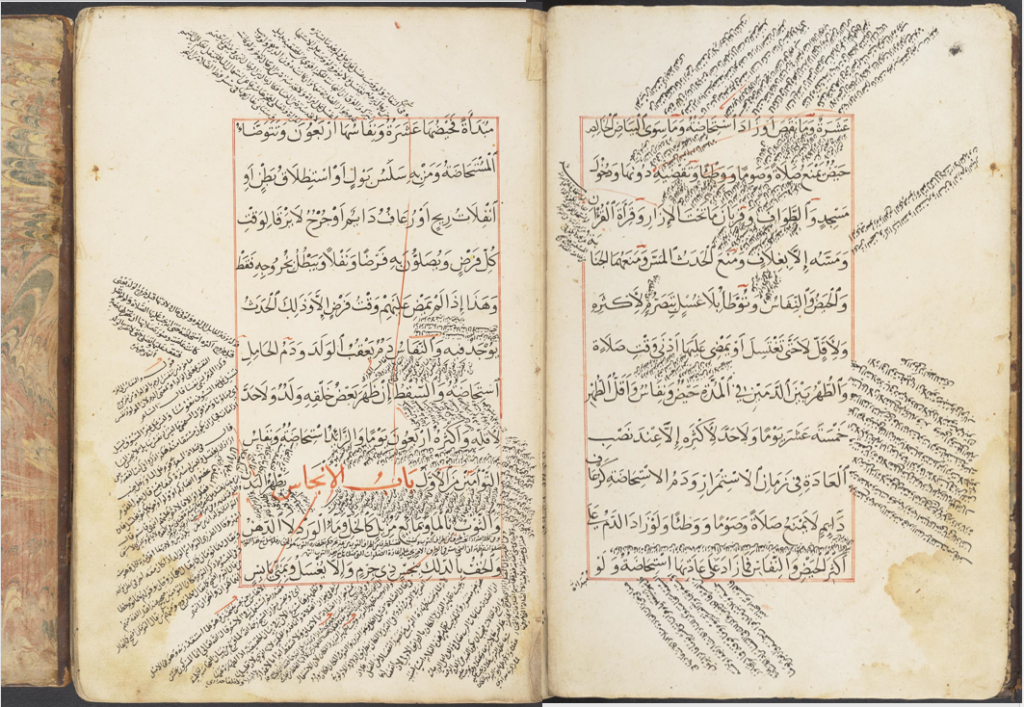
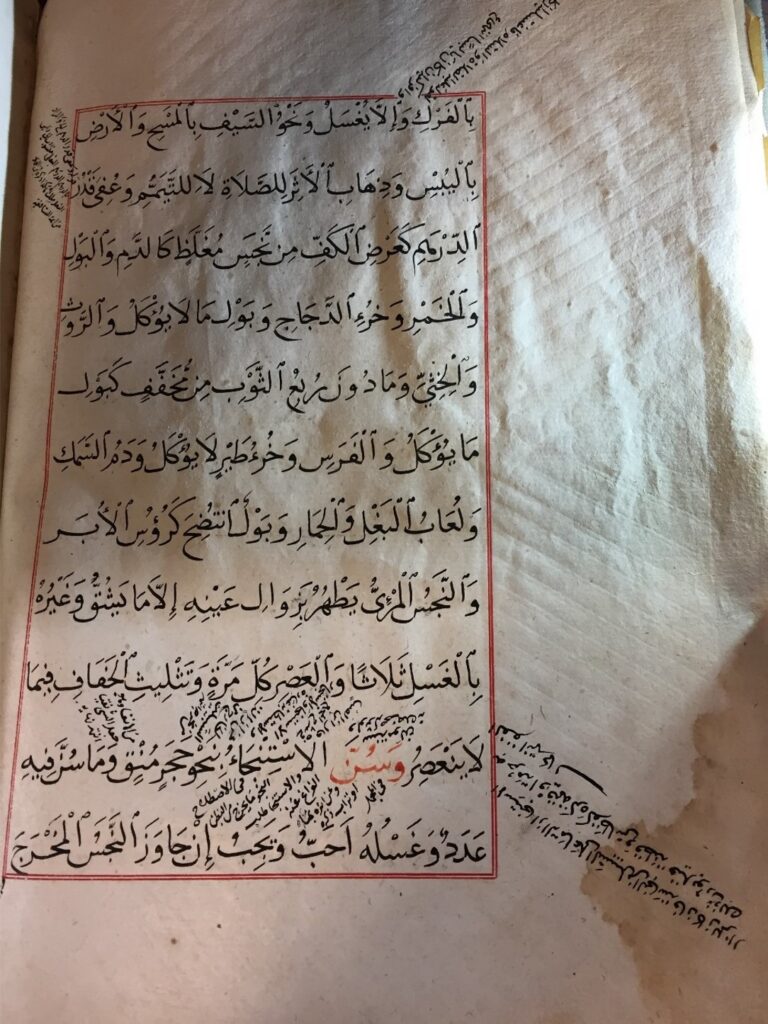
If we look again at a page from this manuscript with the light at an angle (below), we can see the ruling lines made by the ruling board much more clearly. They are especially obvious in the margins. Not only can you see the lines to write on, but you can also see the edge line running up the right side of the image denoting where to stop the marginal lines. If you look back at the image above, you see this quite clearly in how almost all the marginal lines stop at about the same distance from the edge of the page.
Below are two more examples, this time from Turkish manuscripts, both showing ruling lines made by a ruling board. In the example on the left, Columbia University MS Or 32, you can see the particular, diamond-shaped grid layout for this work in the way the words are laid out on the page. The words in black are not straight across the page; they are running at a slight angle.
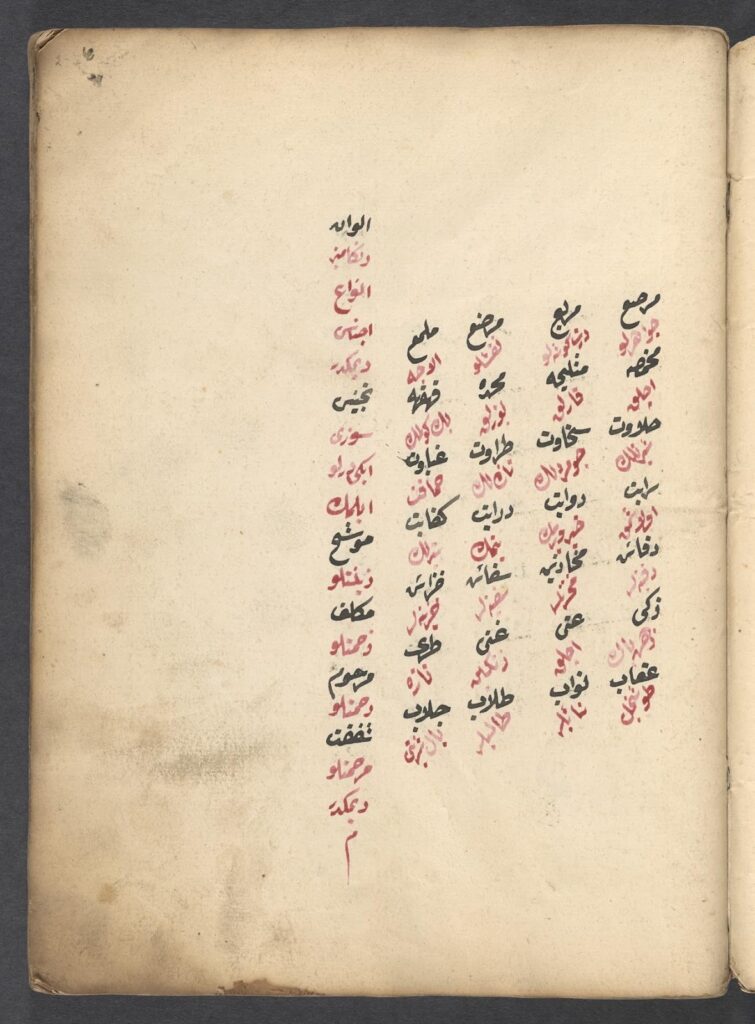
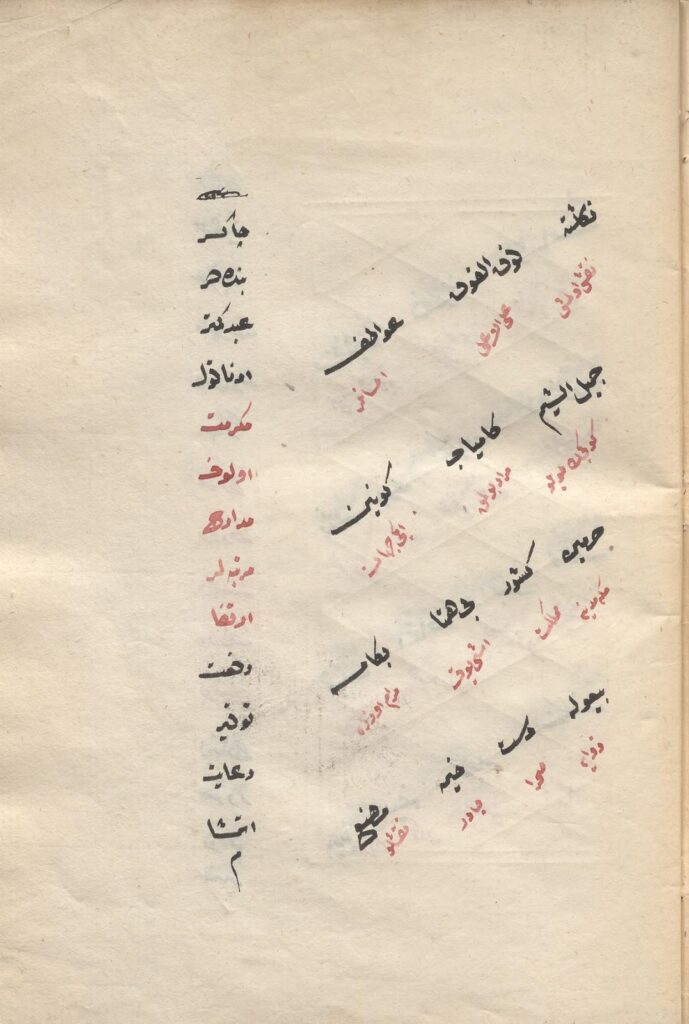
You can enlarge the image to see the rules more clearly (they are clearer where ink has been smudged over them accidentally). As a comparison, on the right is an image that has a similar layout, but the rules are much easier to see and the angle is more dramatic. You can see a larger image on OPenn for this manuscript as well.

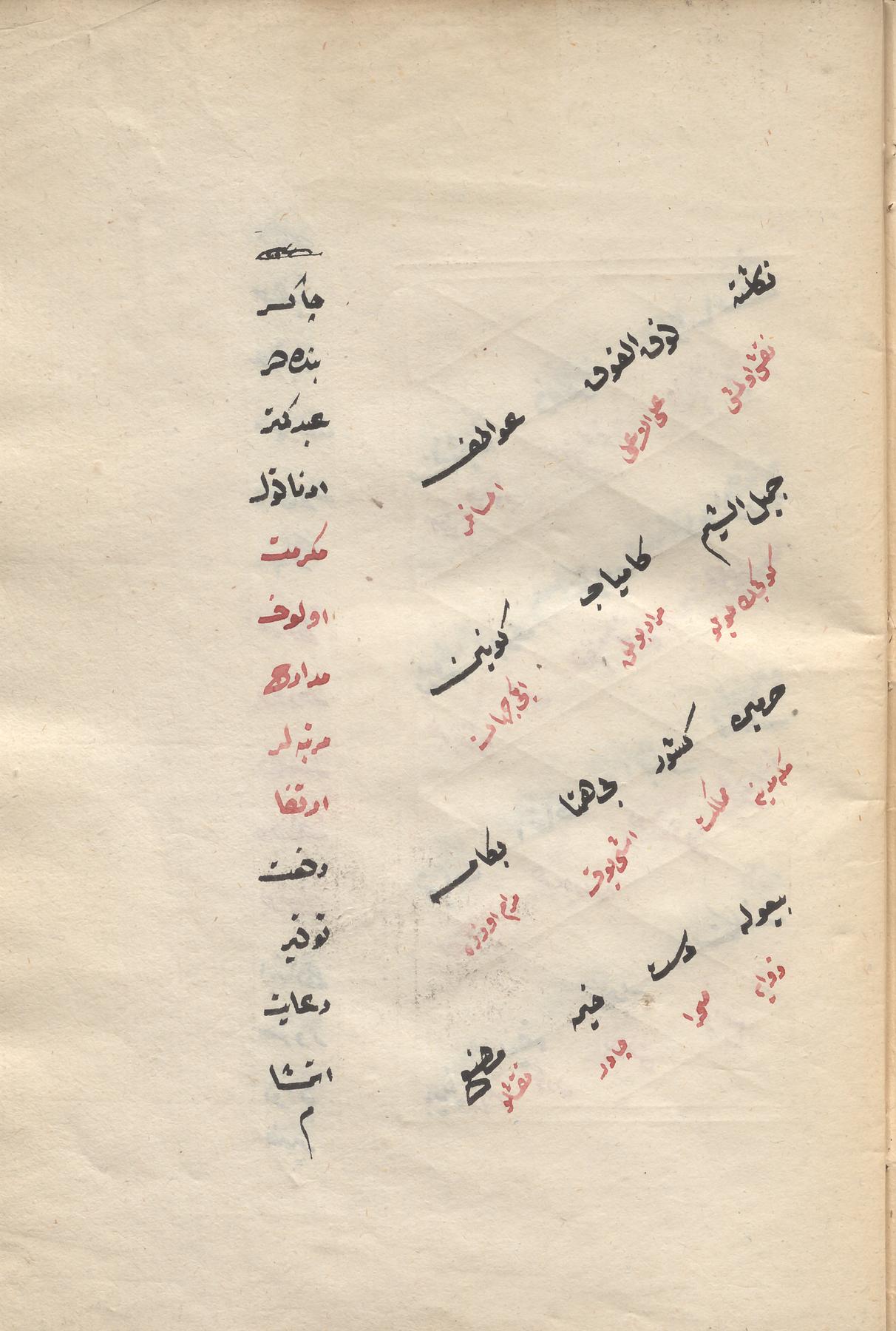
From the examples above, we can see that ruling boards can be made in any pattern for which you need lines, from the very simple, straight across that we saw above to the more complex grid layouts here. The strings making up the lines simply need to be placed differently on the board to make new patterns.
Thanks for joining me on this tour through a few of the rules for writing found in the DS catalog. Guidelines, it turns out, are not just for writing. They are also used in illustration. If you are interested in how guidelines for illustrating work, please attend the upcoming lecture on that topic, Grid as Ground: Ruled Lines and Manuscript Images, hosted by the Schoenberg Institute for Manuscript Studies.