
Posted February 25, 2026 by Kelly Tuttle, Manuscript Data Curation Fellow
Something I like about DS is that it is a collecting and surfacing project and not a digitization project. There is no requirement that items be digitized for inclusion in DS. As much as I love a good digital manuscript project, the lack of digitization requirement is beneficial because it means that items that may not be receiving as much attention because they are not digitized are still surfaced and discoverable in DS. Anyone who wants to investigate them in more detail knows where they can go to see the item in person and do more research. Since creating metadata for items for DS members—be it through minimal records, record revision, or full records—is part of this Data Curation Fellow position, let’s take a brief walk through one manuscript that I was working with recently for Boston Public Library.
This was a record revision request; they had information in the record but wanted to check its accuracy and see if there was anything new that could be added. All images used here were provided by BPL and are informal; this manuscript has not been digitized.
This is MS f. Med 228, a copy of Nizami’s Khamsah, a collection of five long, narrative poems that is sometimes illustrated. The poems it includes are Makhzan-ol-Asrâr, Khusraw o Shīrīn, Leyli o Majnun, Haft Peykar, and the Eskandar-Nâmeh, which has two parts. Boston Public Library’s copy is illustrated, illuminated, embellished with a dual page opening, signed, and dated by the scribe to 961 H or 1554 CE. It also has owner’s notes and stamps, one on the front flyleaf dated to 10 Rabi’ al-Awwal 1263 H or February 26, 1847 CE.
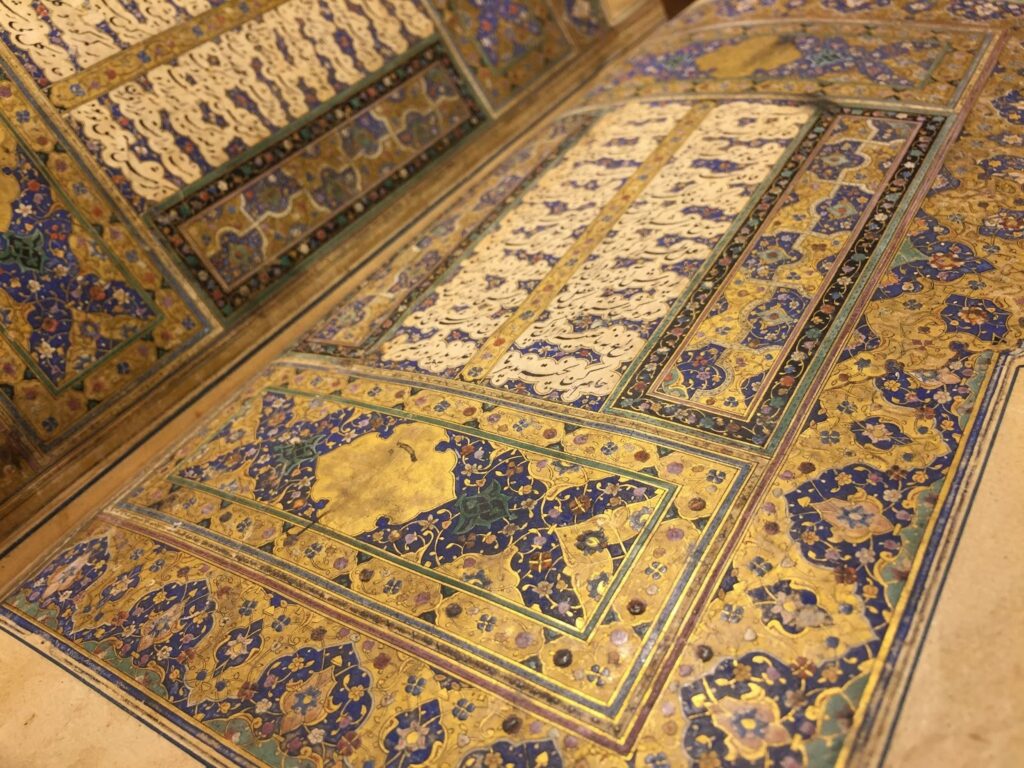
In the dual-page illuminated opening above, you can see the repeating scallop shapes in gold and blue filled in with floral motifs in other colors, primarily pink, red, yellow, and green. The text is on the cloudbands in the center of each page. There are only 11 lines of text on this first opening, but for the rest of the copy there are 21 lines per page written in four columns. Notice the black band running around the rectangles flanking the text box. Those black bands will reappear with other decorations throughout the copy, but in slightly different arrangement and different widths.
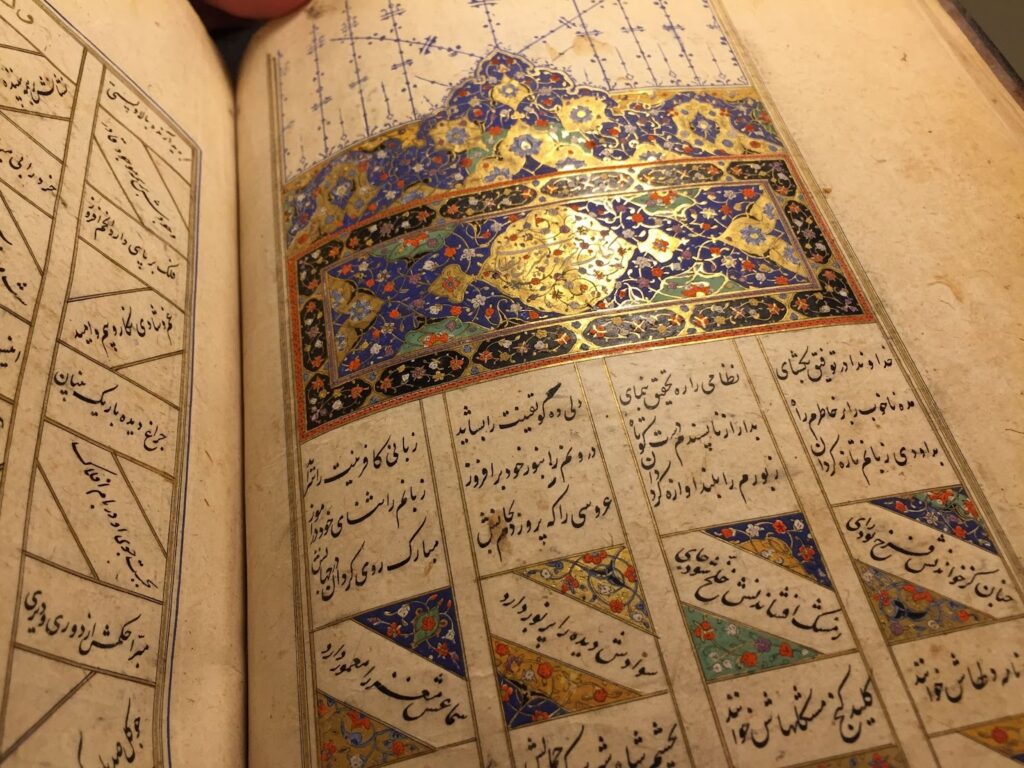
As with many copies of this text, each of the five poems is given a headpiece decoration, called an unvan, at the beginning of the first page of the piece (above). I like in these informal pictures how you can see the gold reflecting the light. You can furthermore see how it is sometimes quite difficult to read white ink on a gold background, such as you see in the middle of the main rectangle of the headpiece, here. That combination of white on gold is quite common, but it can make reading the titles extra tricky with the reflecting light. It is actually much easier to see if you are working with professional digital images since the glare of the gold is mostly gone in such photos. Notice how the decoration in the headpiece is reminiscent of the previous dual-page opening. The same colors and similar shapes are present, but they are arranged differently (look at the black band, for example; it is present, but shaped differently). That is the case for each of the headpieces in this copy. Of the five poems in this collection, only Khosrow o Shirin, the second work (pictured above), has the title written into the headpiece. The others have the same styles and colors but different patterns and blank central cartouches (see all five together below).
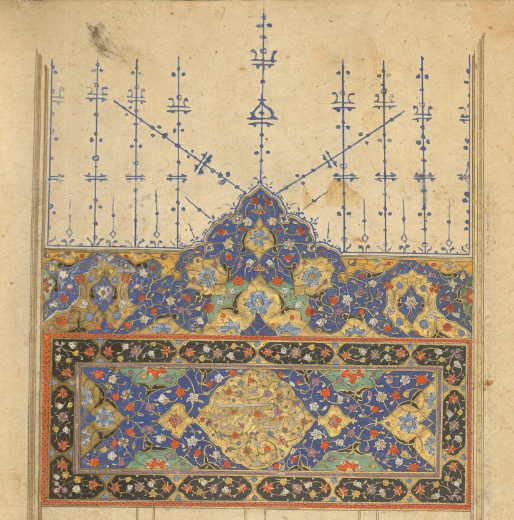
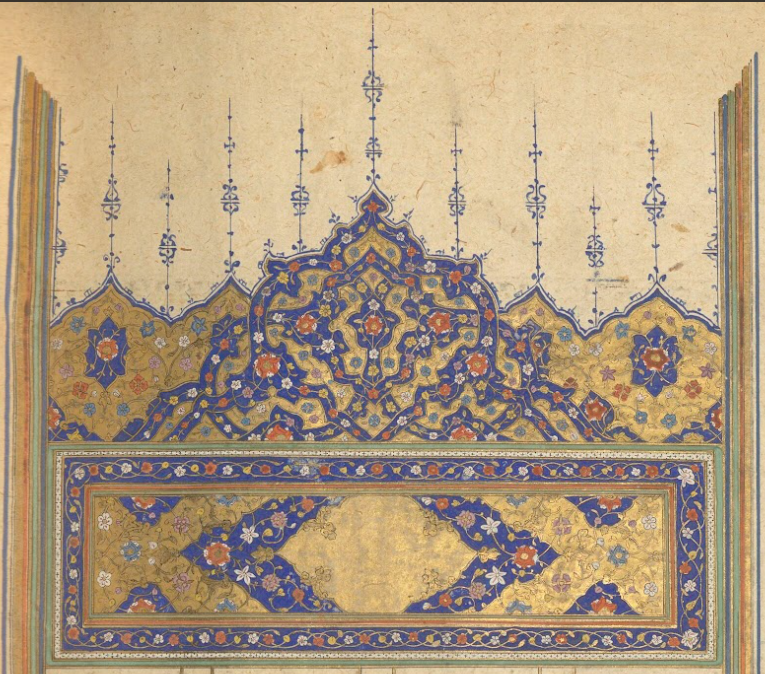
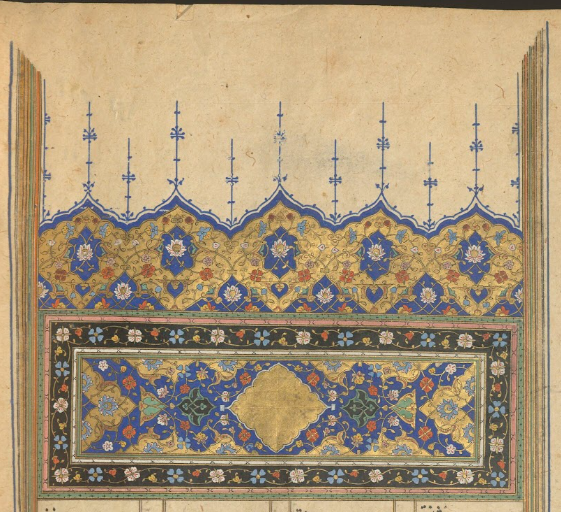
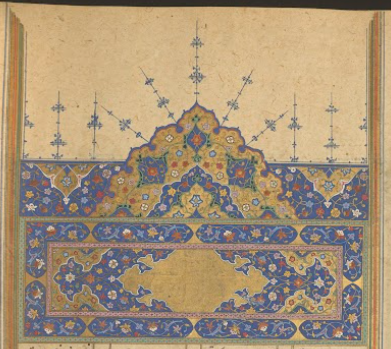
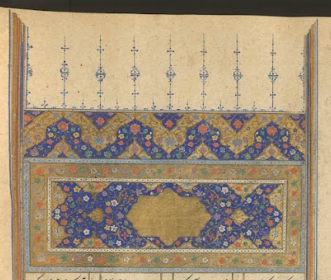
Boston, Boston Public Library, MS f. Med 228. Courtesy of Boston Public Library.
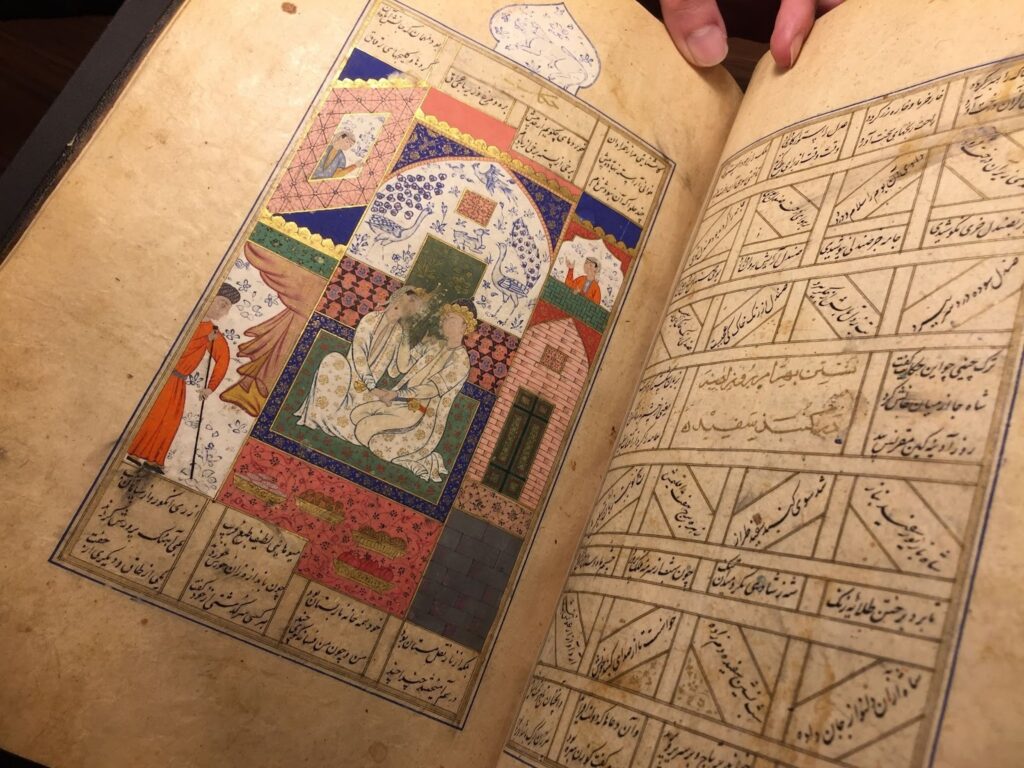
In the image above of the full page with the reflecting headpiece, you can see that some of the lines are written at angles with the empty spaces filled in with florals designs (detail below).
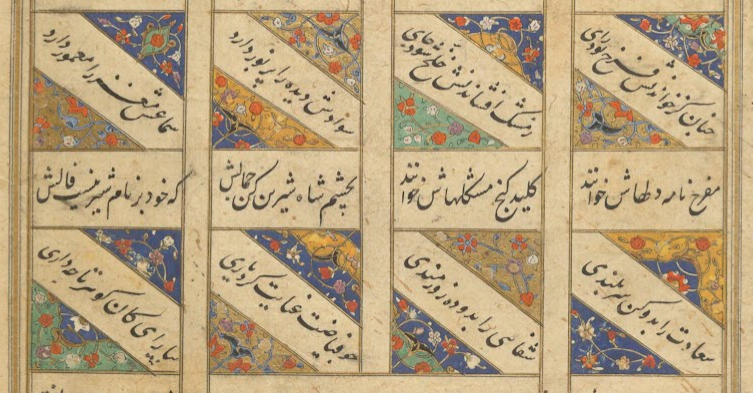
Since this is poetry, it is most commonly written in couplets of two hemistichs that you read across the page (not down the column). So, those tilted lines on the right page above are read across as any line would be, they are just written at angles to take up more space on the page. The spacing continues on the next page, but without the colorful floral infill. Instead, the gold and blue rulings will continue until the end of the poem. The angled lines are to control space and the line placement on the page so that a line related to an illustration will end up in the correct place for that illustration, i.e., at the top of the page with the illustration.
An example is below. Imagine if you wrote all of the angled lines on the right side of the image as straight lines. It would take up far less of the page, then the line for the illustration would be in the middle of the right page leaving less than half a page for the picture. Since that is unsatisfactory, the lines were spaced differently to allow for a full page illustration.
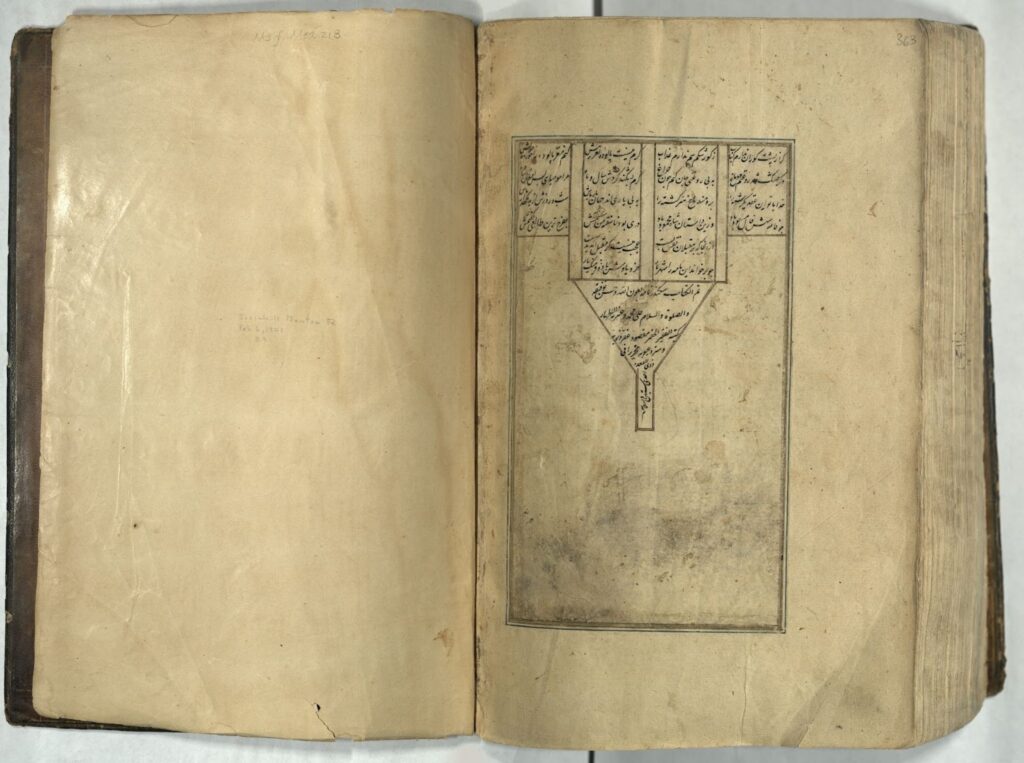
Let’s conclude this brief tour with a look at the colophon for this copy. The colophon (the ending of the book where you sometimes get copyist, date, and place information) below, gives the scribe’s name, Maqsud, and the date: the month of Dhu al-Qa’dah 961 H or October 1554 CE. There is a similar triangle-shaped conclusion to every other section of text in this copy, but unfortunately no more information about the scribe or the dates of completion for the sections appears. Instead, the scribe simply says “this is the end of [insert title here]”. You may also notice in the image below that the paper is quite burnished. You can see it reflecting the light, especially on the upper left page. That is common for Islamicate manuscripts and sometimes the pages are so highly burnished that they make a rather pleasing crackling noise as you leaf through the manuscript.
There are a few other copies of this same work in the DS catalog so far and four have been digitized. You can open those and see what you notice as being similar and different to what you saw here. As for the nondigitized copies, well, you know where they are! Stop by and see one next time you are near that library and if you make more discoveries about what you see, update the library so they can, in turn, update DS.